Begin with the Guest Journey
A sauna is not used like a meeting room, so a uniform grid of bright light is rarely the right answer. Map what the guest sees and does from arrival to departure:
– entering from a brighter changing or relaxation area
– locating the door handle, steps, and available seating
– sitting or reclining without direct glare
– moving safely when the room is dim
– leaving with eyes adapted to low light
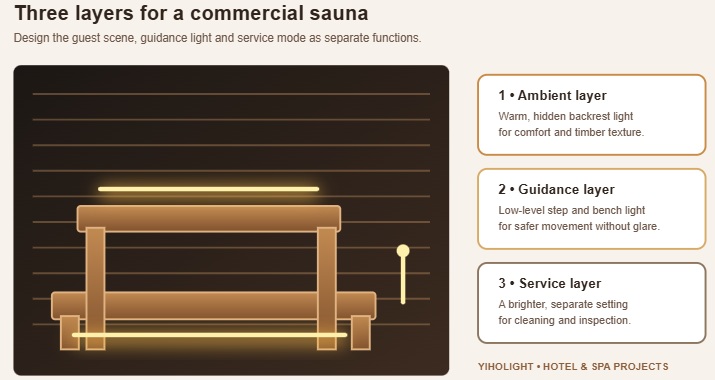
This journey suggests a layered scheme. Door and step lighting provide orientation, hidden backrest lighting creates atmosphere, and a brighter service scene supports cleaning. Separating these functions avoids increasing ambient brightness until the room meets a number but feels uncomfortable.
Build Three Lighting Layers
Ambient Backrest Lighting
The backrest is often the most effective position for a **sauna LED strip for hotels**. It hides the source, reflects light from the timber, and sits below the hottest ceiling zone. Seated guests should not see individual LEDs through gaps or reflections.
Warm white between 2700K and 3000K is a dependable choice for traditional timber interiors. It reinforces the natural warmth of the material and supports a restful mood. Dimming lets the same installation suit a quiet morning session, a busier evening period, or different brand standards across properties.
Low-Level Guidance Lighting
Under-bench and step lighting defines changes in level without flooding the room. Shield it from normal sightlines and coordinate it with the floor finish. Pale tile, glass, and metal can create bright reflections, so judge the detail in a mock-up. Avoid broken lines, dark connections, and mismatched white tones.
Cleaning and Service Lighting
Housekeeping and engineering teams need to inspect floors, bench supports, corners, and surfaces. Instead of forcing the guest scene to remain overly bright, provide a separate service setting. This may use a higher dimming level, an additional rated luminaire, or both.
Controls for this scene should be simple and clearly labeled. Keep the driver, controller, and user interface outside the hot chamber unless they are explicitly suitable for that environment.
Choose White or RGBW Based on the Operating Concept
Color is a brand and operations decision, not just a feature.
Warm White for Timeless, Simple Operation
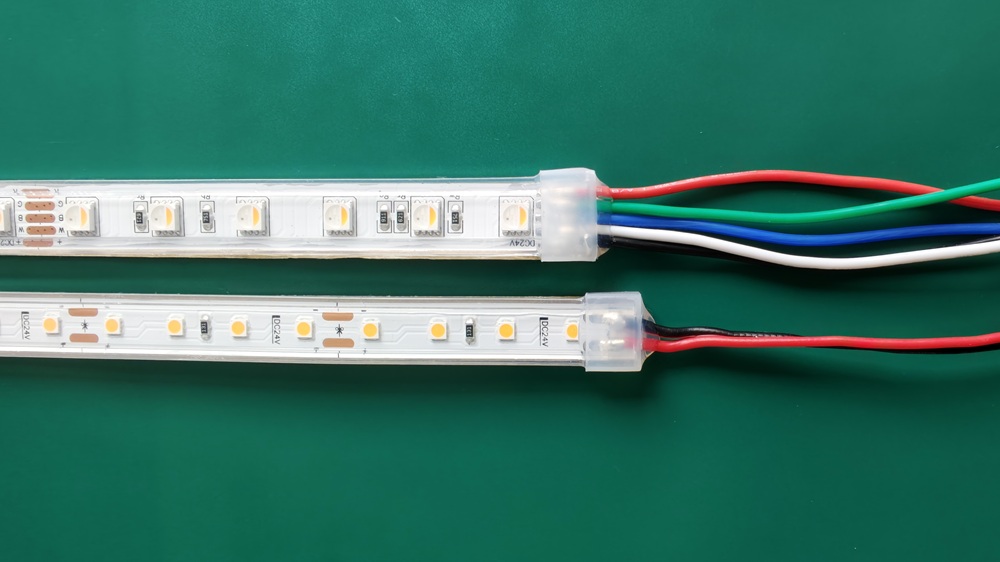
Single-white light is intuitive for guests and staff. It requires fewer control channels, makes scene programming simpler, and fits Nordic, natural, and quiet-luxury design concepts. Yiholight’s white sauna strip configurations use 24V and are available from 2700K to 6000K.
The YH-DA30L80V2412-W is listed with 80 LEDs/m, a 12mm PCB, IP65, and a 50mm cut interval. A 4.8W/m version provides up to 734lm/m; a 9.6W/m version provides up to 1600lm/m. Higher output is not automatically better: concealment, dimming, reflectance, and spacing all affect the result.
RGBW for Programmed Wellness Experiences
An RGBW sauna LED strip can support chromatic scenes while retaining a dedicated white channel. This makes it more suitable than RGB alone when the room also needs a natural everyday white setting.
Yiholight’s YH-DA50L60V2414-RGBW is listed at 24V, 10W/m, 60 LEDs/m, 14mm width, IP65, and a 100mm cut interval, with RGB plus white output. It can support branded welcome scenes, calm blue or green accents, and warm white general use.
Pre-program a few approved scenes, define default behavior after power loss, and provide a physical override. Rapid effects may feel more like entertainment than wellness, and staff should not need an app tutorial to start a session.
Specify for the Actual Heat and Moisture Exposure
Dry saunas, steam rooms, infrared cabins, and relaxation rooms have different environmental profiles. Conditions also change by mounting height and distance from the heater.
Yiholight’s sauna LED strip family is designed for high-temperature, high-humidity locations, with published operation from -25°C to 100°C. At design stage, record the expected temperature at every proposed strip location. Then verify the rating of the complete assembly, including strip, encapsulation, cable, connectors, seals, clips, and control components.
Match the IP rating to real exposure. A hidden strip behind a dry bench differs from a lower run exposed to cleaning water or constant condensation. Waterproofing and temperature resistance are separate requirements.
Avoid direct heater exposure regardless of the strip rating. A heater, flue, stones, and nearby surfaces can create intense radiant and localized heat that is not represented by the room thermostat.
Design Out Maintenance Cost
Product price is only one part of spa sauna lighting cost. Closing a room, removing timber, repairing finishes, and losing bookings can exceed the cost of a replacement strip.
Keep Equipment Accessible
Locate drivers, controls, protection, and distribution points outside the sauna in a ventilated service area. Provide removable access to strip leads and connections.
Standardize Repeatable Sections
Across multiple cabins, standard lengths and cable arrangements simplify installation and spares. Factory-prepared sections reduce field-cut ends. Record model, color temperature, batch, length, connector orientation, and lead length.
Separate Circuits by Function
Put backrest, under-bench, and feature lighting on logical circuits. Separate circuits simplify scene setting and fault finding and may keep part of the room operational during service.
Protect the Installation Mechanically
Adhesive backing should not be the only support in a high-temperature environment. Use compatible clips, channels, or project-specific retention details. Position low-level strips where cleaning tools and shoes will not strike them, and add strain relief at every cable transition.
Document What Is Hidden
Photograph wiring before the timber closes. Leave a circuit schedule in the service area and a digital copy in the asset record. A QR code can link to data, drawings, and approved parts.
Use a Mock-Up to Protect Both Design and Budget
A one-meter sample detail can answer questions that renderings cannot:
– Are individual LEDs visible from the upper bench?
– Does the timber absorb more light than expected?
– Is the 4.8W/m option sufficient, or is 9.6W/m with dimming more suitable?
– Does glass create a distracting reflection?
– Can staff remove and replace the strip without damaging the joinery?
– Do the seals, clips, cable, and finish tolerate a complete heat-and-cool cycle?
For a multi-site rollout, this small prototype can prevent an expensive repeated mistake. Approve the visual detail and service method together.
A Commercial Procurement Checklist
Ask potential suppliers for information that matches the project rather than accepting a generic datasheet. The purchasing package should confirm:
1. operating temperature for the specified strip configuration
2. IP rating and sealing method for factory and field terminations
3. voltage, wattage per meter, maximum run, and feed arrangement
4. LED density, color temperature, output, CRI, and color tolerance
5. cut interval, minimum bend radius, and mechanical mounting method
6. cable temperature rating, lead length, and connector details
7. controller protocol, dimming compatibility, and power-loss behavior
8. driver location, capacity, and access requirements
9. test samples, custom lengths, labeling, and spare-part availability
10. OEM/ODM support for repeat hotel or sauna-manufacturer programs
Yiholight supports custom PCB dimensions, LED density and power, packaging, branding, connectors, and controls. For multi-site programs, use a controlled bill of materials so repeat orders remain consistent.
Plan Controls for Guests and Staff
Guest controls should offer a few clear choices: on/off, brightness, and perhaps approved scenes. Facility controls may add scheduling, output limits, service mode, or room-system integration.
Define responsibility for programming. Save RGBW scene values and channel order so a replacement controller reproduces the brand-standard default.
In commercial facilities, simplicity is a form of reliability. Every extra gateway, app, and wireless dependency should deliver a clear operational benefit.
Frequently Asked Questions
What color temperature is best for a hotel sauna?
Warm white from 2700K to 3000K is a strong default for timber interiors and relaxation-focused spaces. The final choice should be approved against the actual wood, wall, and floor finishes.
Is RGBW suitable for commercial sauna lighting?
Yes, when the strip and complete installation are rated for the environment. RGBW is useful for programmed wellness scenes because it combines colored light with a dedicated white channel. Keep the guest interface simple and include a reliable default white scene.
How can hotels reduce sauna lighting downtime?
Keep drivers and controls outside the chamber, provide access to connections, standardize strip sections, document hidden wiring, keep approved spares, and divide the lighting into logical circuits.
Should a hotel use the brightest available strip?
Not necessarily. Guest comfort depends on glare control, concealment, surface reflectance, dimming, and uniformity. Select output through a mock-up rather than by comparing lumen figures alone.
Turn a Hidden Component into a Better Guest Experience
Well-designed commercial sauna lighting feels effortless because the technical work remains invisible. Guests see warm timber, clear steps, and a coherent atmosphere. Staff see accessible equipment, repeatable parts, and a room that is easier to inspect and maintain.
For a hotel, spa, gym, sauna cabin, or multi-site wellness program, Yiholight can support single-white and RGBW sauna LED strip configurations, custom lengths, control solutions, and OEM/ODM requirements. Send the room drawings, material palette, operating temperatures, lighting scenes, and rollout quantity to the Yiholight team for a project-specific recommendation and sample.
Learn more:
How to Design Sauna LED Strip Lighting by Temperature Zone
How to Test Sauna LED Strips Before a Bulk Order
Best Sauna Light Colors: Warm White, Tunable White, or RGBW
Why Sauna LED Strips Fail: 10 Problems, Causes, and Prevention Steps
As a bespoke lighting solution provider, Yiholight specializes in high-quality LED strips and neon flex. Our products are engineered for durability, brightness, and ease of installation—trusted by B2B customers across the globe.
Contact us today to explore the best LED lighting for your business!
© [Yiholight] and [www.yiholight.com]. Unauthorized use or duplication of this material is strictly prohibited without express written permission from the site’s author or owner. Excerpts and links may be used, provided full, clear credit is given to [Yiholight] and [www.yiholight.com], with appropriate, specific direction to the original content.