The best sauna light color is not selected from a catalog in isolation. A 2700K strip can look golden against cedar, softer against pale aspen, and muddy when reflected from a dark stained wall. Brightness, dimming, strip concealment, timber finish, and the guest’s adaptation from the adjacent room all influence what the eye finally sees.
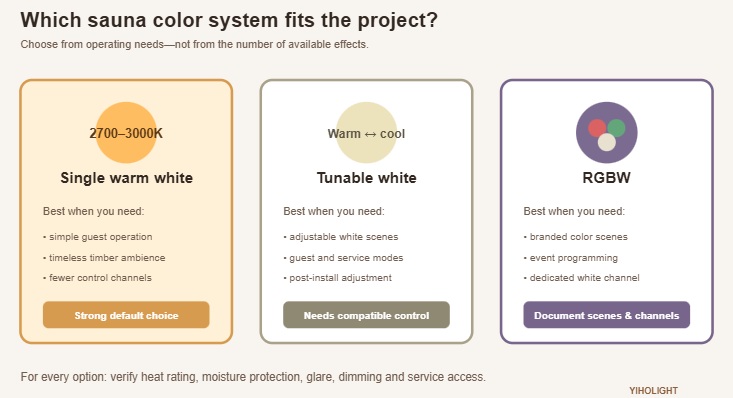
For most traditional saunas, warm white remains the safest starting point. Tunable white adds flexibility, while RGBW supports branded or programmed scenes. This guide compares the options without making unsupported wellness claims and shows how to test color in the real interior.
Why Kelvin Is Only the Beginning
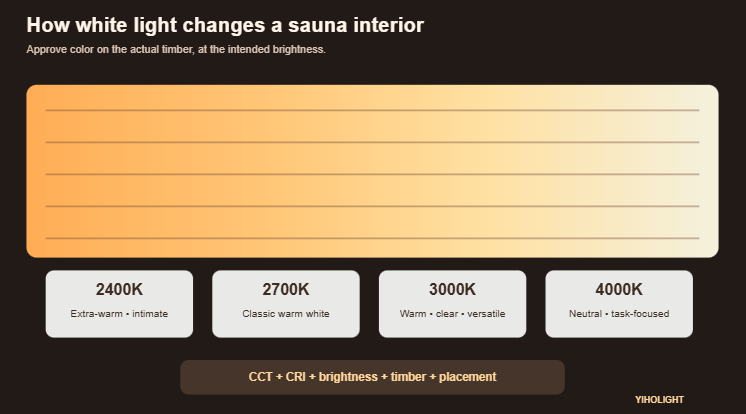
Color temperature, expressed in kelvin (K), describes whether white light appears warmer or cooler. Lower values look more amber; higher values look more neutral or bluish. It does not describe brightness, color rendering, tint, uniformity, or how the material will reflect the light.
Two LED strips both labeled 3000K can appear different because of color tolerance, LED bin, optics, dimming method, surrounding finishes, and the viewer’s point of comparison. A sauna entered from a cool-white changing room may initially make 3000K look very warm. After several minutes, the eye adapts.
For this reason, specify CCT together with CRI, acceptable color consistency, dimming performance, and an approved physical sample.
2400K–2700K: Extra-Warm and Intimate
Extra-warm white emphasizes amber and red tones. It can suit dark hospitality interiors, compact private saunas, or designs intended to evoke firelight without exposing users to a visible source.
Advantages include:
– intimate, low-stimulation appearance
– strong compatibility with rich cedar and darker timber
– less visual conflict with warm decorative lighting outside the sauna
Possible limitations include:
– pale wood may appear more yellow than intended
– low-output amber light can reduce the perception of clarity on steps and floors
– color differences between batches can become visible on long continuous lines
Use extra-warm color as an ambient layer, then confirm that separate guidance or service lighting provides adequate visibility.
2700K: The Classic Warm-White Choice
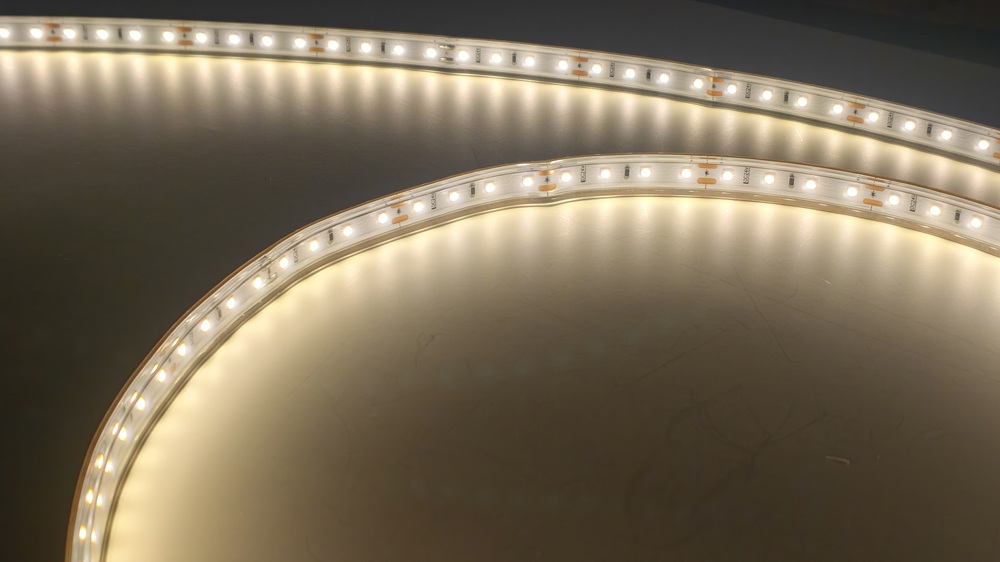
For designers asking about **2700K vs 3000K sauna lighting**, 2700K is the more residential and candle-like option. It supports a cozy atmosphere and usually complements cedar, hemlock, and warm-toned finishes.
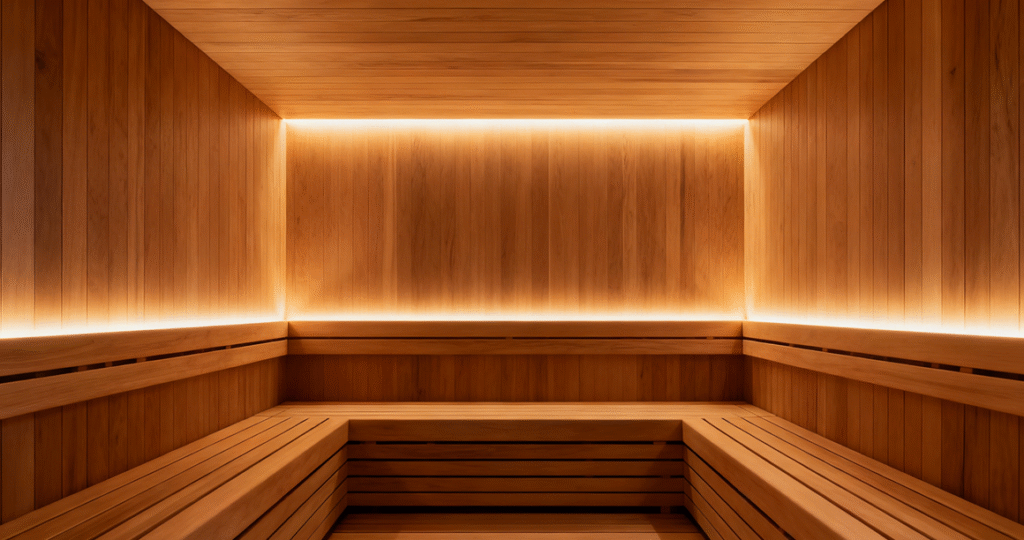
It works especially well behind backrests and beneath benches, where the source is hidden and timber becomes the reflector. The indirect path softens brightness and makes the light feel integrated with the architecture.
Check the adjacent space. If the spa corridor uses 4000K, the transition to 2700K may feel dramatic. That can be intentional, but it should be previewed as part of the guest journey.
3000K: Warm, Clear, and Versatile
3000K remains warm while appearing slightly clearer and less amber than 2700K. It is a practical choice for hotels, gyms, and contemporary saunas where staff need a consistent default scene and the interior includes pale timber, stone, or tile.
At the same measured output, 3000K may be perceived as a little brighter than 2700K. It can therefore balance relaxation with orientation. Dimming allows the room to feel softer during guest use and brighter during cleaning, although a separate service light may still be appropriate.
When a project team cannot agree between 2700K and 3000K, a side-by-side mock-up on the production timber is more useful than descriptions such as “cozy” or “clean.”
3500K–4000K: Contemporary or Task-Focused
Neutral white reveals more detail and can suit certain modern infrared cabins, light timber interiors, or maintenance scenes. It is less typical for a traditional relaxation-focused sauna because it may feel clinical at high brightness.
This does not make 4000K wrong. The result depends on intensity, concealment, surface color, and brand concept. A low-level 4000K line can appear refined, while an exposed high-output line at eye level can feel harsh.
Consider neutral white for a separate cleaning scene or tunable system rather than assuming it should be the primary guest color.
Tunable White: Flexibility with More Controls
Tunable white changes between warm and cooler white using two or more LED channels. It can support different operating modes:
– warm, dim guest scene
– clearer pre-opening inspection scene
– brand-specific settings for different cabin models
– adjustment after final timber and interior finishes are installed
The flexibility comes with extra design work. The strip, controller, driver capacity, cabling, and interface must all be compatible. Scene values should be saved and documented so replacement controllers reproduce the approved CCT and output.
Avoid presenting tunable white as an automatic circadian solution inside a sauna. Session duration, intensity at the eye, time of day, and the wider environment all matter. Specify it for controllable appearance and operational flexibility unless the project has expert-supported health requirements.
RGB Versus RGBW for Sauna Mood Lighting
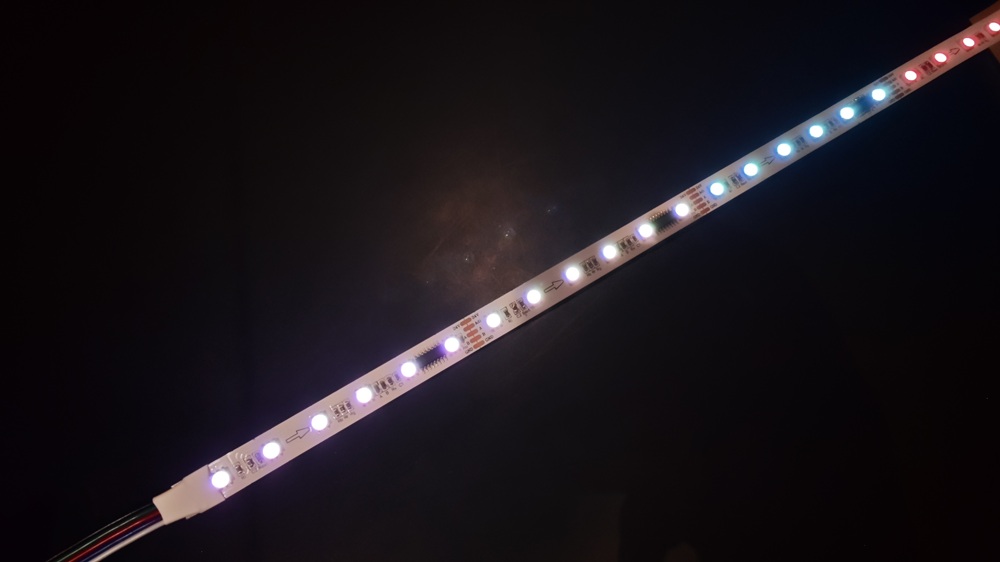
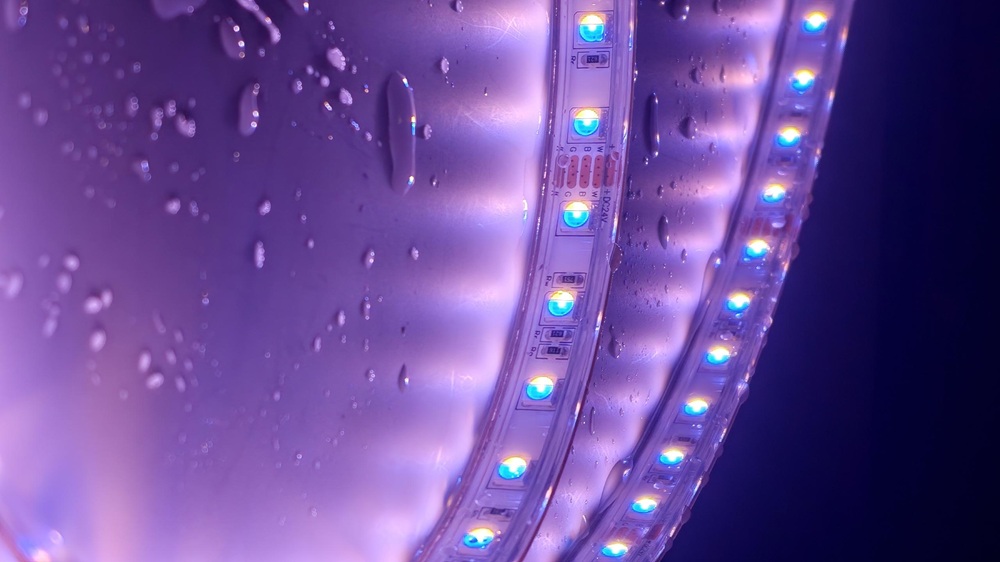
RGB combines red, green, and blue channels to create many colors. An **RGBW sauna LED strip** adds a dedicated white channel, allowing a more natural everyday white than a mixture of RGB alone.
For a commercial sauna, RGBW is usually the more versatile color-changing choice because the room can return to a practical warm-white default. Yiholight’s listed YH-DA50L60V2414-RGBW operates at 24V and 10W/m, with 60 LEDs/m, a 14mm width, IP65 protection, a 100mm cut size, and RGB plus white output.
RGBW can support:
– a restrained brand-color welcome scene
– slow, subtle transitions
– event or seasonal programming
– individual cabin themes
– a dedicated white scene for daily operation
It should not be used to imply medical treatment without appropriate evidence and regulatory review. Terms such as “chromotherapy” may carry different expectations in different markets. Describe the system accurately as color-changing or mood lighting unless qualified claims are supported.
Color Rendering Matters Even in a Timber Room
CRI indicates how naturally colors appear compared with a reference source, but the general CRI value is not the complete story. Rich wood tones, skin, towels, stone, and branded finishes may respond differently to the spectrum.
Higher color quality can make timber grain look richer and users look more natural. For premium hospitality projects, evaluate skin tone and material samples, not only a numeric specification. Confirm that the heat-resistant configuration provides the required CRI; do not assume every version of a product family has identical output or color performance.
Brightness Changes the Perception of Color
Warm light at low intensity can feel relaxing, while the same CCT at very high brightness may feel glaring. As LEDs dim, the visual result also depends on the control method and whether the CCT remains stable.
Yiholight’s listed white sauna strip family includes 4.8W/m and 9.6W/m options. The published output reaches up to 734lm/m for the 4.8W/m configuration and up to 1600lm/m for the 9.6W/m configuration, depending on the selected version and CCT. These figures describe the strip, not the light reaching the bench after concealment and reflection.
Select output through a mock-up. A higher-output strip with deep dimming can provide flexibility, but it also increases connected load and may expose low-level flicker or uneven dimming if the driver and controls are poorly matched.
Placement Can Be More Important Than Color
A well-selected 2700K strip will still feel uncomfortable if users can see bright LED points. Design the light path first:
– behind backrests for a soft vertical wash
– beneath benches for floating low-level light
– at steps for guidance without direct glare
– in ceiling coves only when the complete assembly suits the hotter zone
Keep strips away from the heater and direct radiant heat. Use mechanical support and protect every cut end. Drivers and controls should remain outside the chamber unless explicitly rated for the measured conditions.
Diffusion distance matters. A shallow detail may reveal individual points even with a frosted cover. Sauna LED neon flex can provide a smoother line in suitable high-temperature configurations, while strip lighting can be more compact and easier to integrate into hidden coves. Evaluate both against the bending, output, size, and environmental requirements.
Create a Simple Scene Strategy
More scenes do not necessarily improve the guest experience. A useful commercial program may include:
1. Welcome: warm white at a moderate level for safe entry.
2. Relax: warmer or dimmer indirect light for normal use.
3. Color: one or two slow RGBW scenes for optional mood lighting.
4. Service: brighter white for inspection and cleaning when unoccupied.
Define the default after power loss, maximum guest brightness, transition speed, and physical override. Staff should be able to operate the room without accessing engineering menus.
How to Approve the Final Sauna Light Color
Build a full-size section using the production timber, stain, backrest spacing, diffuser or channel, and intended strip distance. Install two candidate CCTs side by side where possible.
Review the mock-up:
– from the upper and lower bench
– from the entrance with the adjacent room lit
– at full output and the normal dimmed level
– after the strip and room have reached operating temperature
– through glass and reflected surfaces
– with towels, signage, and other real interior colors
Use fixed camera settings for documentation; automatic white balance can make different colors appear falsely similar. Mark the approved strip model, CCT, batch, dimming value, and installation dimensions.
Frequently Asked Questions
Is 2700K or 3000K better for a sauna?
2700K feels warmer and more intimate; 3000K feels slightly clearer and more versatile. Both are popular. Choose using a mock-up with the actual timber and adjacent-room lighting.
Are red or blue sauna lights better for wellness?
Colored light can change ambience, but specific health claims require appropriate evidence. Use RGBW for controllable mood and a dedicated white scene, not as a substitute for medical treatment.
Does a higher CRI make sauna lighting warmer?
No. CRI and color temperature describe different characteristics. CCT indicates warmer or cooler white appearance; CRI relates to color rendering.
Can sauna light color change when the room heats up?
LED output and materials can shift under temperature. A qualified product should be evaluated through the intended operating range, and the complete installation should be tested under normal conditions.
Select the Scene, Then Specify the System
The best sauna light color supports the interior, guest journey, and operating model. Warm white is a strong default, tunable white offers controlled flexibility, and RGBW adds color without giving up a dedicated white channel. The final decision should be made on production materials at realistic brightness and temperature.
Yiholight supplies heat-resistant white and RGBW sauna LED strip options and supports custom lengths, connections, controls, and OEM/ODM programs. Share your material palette, lighting detail, target CCT, scene list, and project quantity to request a suitable sample.
Learn more:
Sauna & Steam Room LED Strip Lighting: Special Requirements You Must Know
LED Sauna Lights: What They Are, Why They Matter, and How to Use Them
How to Design Sauna LED Strip Lighting by Temperature Zone
Commercial Sauna Lighting for Hotels and Spas
As a bespoke lighting solution provider, Yiholight specializes in high-quality LED strips and neon flex. Our products are engineered for durability, brightness, and ease of installation—trusted by B2B customers across the globe.
Contact us today to explore the best LED lighting for your business!
© [Yiholight] and [www.yiholight.com]. Unauthorized use or duplication of this material is strictly prohibited without express written permission from the site’s author or owner. Excerpts and links may be used, provided full, clear credit is given to [Yiholight] and [www.yiholight.com], with appropriate, specific direction to the original content.