Define the Application Before Requesting Samples
The supplier cannot recommend the right configuration without operating conditions. Prepare a one-page application brief covering:
– dry sauna, steam room, infrared cabin, or adjacent relaxation area
– expected temperature at each proposed strip location
– humidity, condensation, splash, and cleaning exposure
– distance and line of sight from the heater
– installation position: backrest, bench, step, wall, or ceiling
– required white color, RGBW, tunable white, and dimming method
– strip length, number of circuits, cable routes, and supply location
– target market and relevant project requirements
Do not write only “up to 100°C sauna.” A strip behind a lower bench and a strip in a ceiling cove face different conditions. Provide a drawing and mark the expected zones.
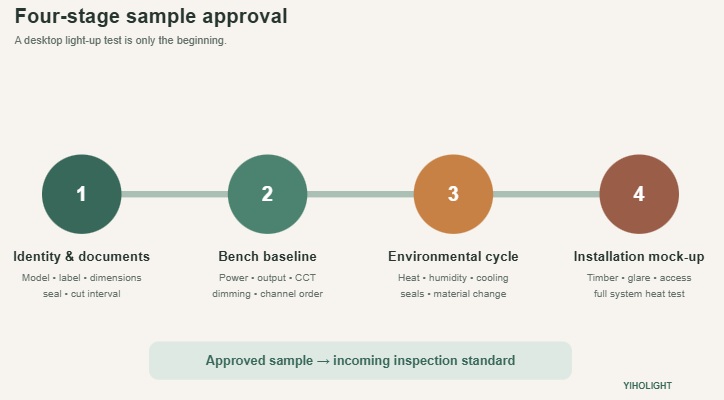
Sauna LED Strip Testing Stage 1: Review Documents and Sample Identity
Before applying power, compare the sample with its quotation, datasheet, label, and approved configuration. Record the model, lot or date code, voltage, wattage per meter, CCT, IP construction, width, cut interval, cable type, and lead orientation.
For Yiholight’s listed sauna LED strip range, examples include:
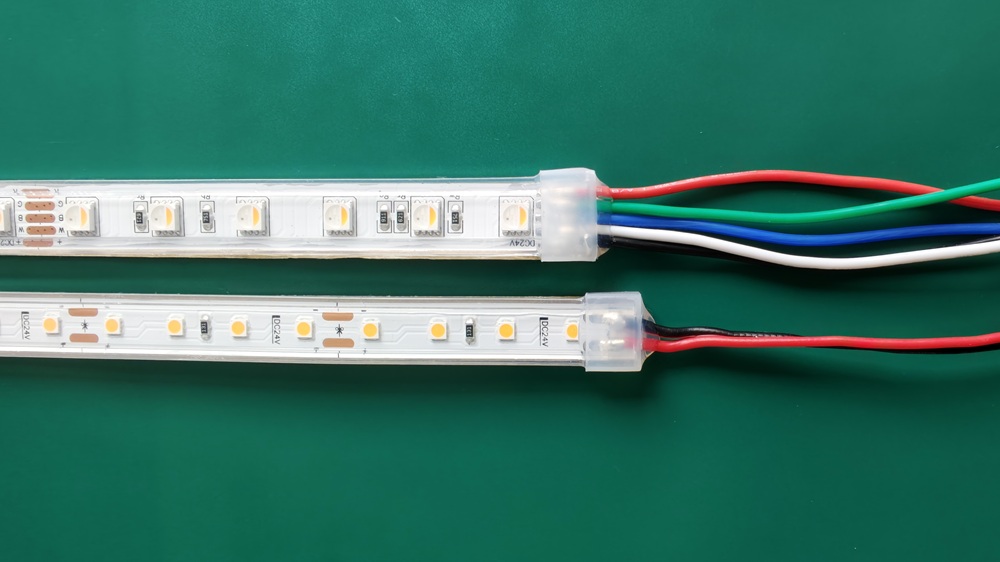
– YH-DA30L80V2412-W: 24V, 12mm width, 80 LEDs/m, IP65, 50mm cut size, with 4.8W/m and 9.6W/m white configurations.
– YH-DA50L60V2414-RGBW: 24V, 14mm width, 60 LEDs/m, 10W/m, IP65, and 100mm cut size.
Confirm which exact version was sampled. A model family can contain several power or color options; test data is meaningful only when it can be traced to the delivered configuration.
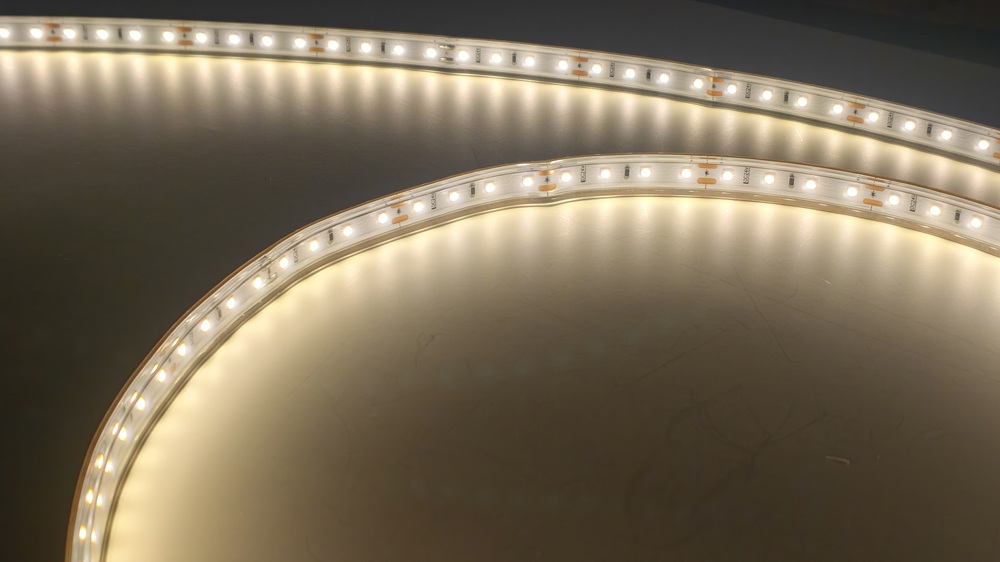
Inspect the unpowered sample under good light. Look for consistent encapsulation, centered PCB, clean end seals, undamaged cable entry, correct polarity marking, regular LED spacing, and no trapped debris or visible bubbles in critical sealing areas. Measure width and height where the strip must fit a channel or joinery detail.
Sauna LED Strip Testing Stage 2: Establish a Room-Temperature Baseline
The baseline lets you compare performance after environmental testing. Use a regulated supply at the rated voltage and test a representative length with the intended driver and controller.
Record:
1. input voltage at the feed and far end under load
2. current and calculated power per meter
3. startup behavior and time to stable output
4. visible brightness and uniformity
5. surface temperature at defined points
6. dimming range and low-level stability
7. color-channel operation for RGBW
8. photos taken with fixed camera settings
If photometric equipment is available, measure illuminance at a fixed distance, CCT, CRI, and color consistency. The purpose is not to recreate a certified laboratory report; it is to build a repeatable comparison between the approved sample and later deliveries.
For RGBW, test each channel individually and in approved mixed scenes. Confirm channel order, controller capacity, white-channel quality, and behavior after power interruption. Save scene values as part of the project record.
Stage 3: Run Heat and Moisture Tests Relevant to the Project
A useful heat-resistant LED strip test should represent the specified use without exceeding the product’s rating or creating an uncontrolled hazard. Testing can be performed by a qualified internal laboratory or an independent test provider using appropriate equipment.
Heat Exposure
Mount the sample using the intended clips or profile on a representative substrate. Operate it at the specified load while the chamber follows an agreed high-temperature cycle. Monitor ambient temperature, strip surface temperature, current, output, and visible changes.
Avoid testing a loose coil. Coiling changes heat dissipation and can create an unrealistic hot spot. The installation method is part of the thermal system.
After exposure, inspect for:
– dim or failed LEDs
– color shift or uneven white
– yellowing, cracking, swelling, or softening
– lifted seals or cable movement
– deformation of clips or channels
– changes in current or voltage behavior
Yiholight publishes an operating range of -25°C to 100°C for its sauna LED strip family. The test limit and cycle should be agreed for the selected model and actual application. A product rating should never be interpreted as permission to place the strip beside a heater or open flame.
Humidity and Condensation
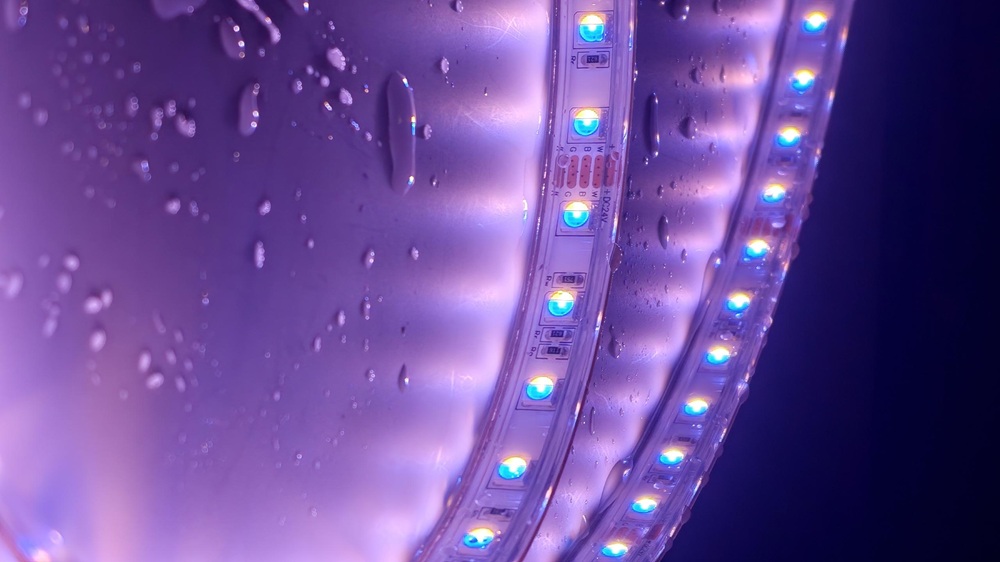
Sauna and steam-room moisture exposure is not identical. A dry sauna has repeated heat-and-cool cycles; a steam room may expose the assembly to near-continuous condensation. Define which condition the sample must represent.
Inspect field-cut and factory-sealed ends separately. Moisture frequently enters at terminations, cable exits, or damaged encapsulation rather than through the main body. After the cycle, allow the sample to cool and inspect for droplets, haze, corrosion, intermittent operation, or insulation changes.
Combined Cycling
Repeated cycling is often more informative than one long exposure. Expansion and contraction challenge solder joints, seals, cable entries, clips, and the bond between different materials. A sample that works while hot should also be inspected and retested after cooling.
Stage 4: Build a Full-Size Installation Mock-Up
Laboratory checks cannot answer every design question. Build at least one representative backrest, bench, step, or cove section using the production timber, diffuser or channel, fasteners, cable route, and surface finish.
The mock-up should answer:
– Can users see individual LEDs from realistic seated positions?
– Is 4.8W/m sufficient, or is a higher-output version with dimming preferable?
– Does the timber color shift the appearance of 2700K or 3000K?
– Are reflections visible in glass, tile, or metal?
– Can the strip expand without buckling?
– Can maintenance staff access and replace it?
– Do cleaning methods expose the strip or seals to direct water?
Run the mock-up through normal operating cycles. Photographs should include the approved camera position and dimming level so future changes can be compared consistently.
Test the Complete System, Not Just the Strip
Many field failures originate in components that were not included in sample approval. The production test set should include:
– the intended LED driver and its loading
– dimmer or RGBW controller
– cable type and representative cable length
– connectors and distribution terminals
– end caps and sealant
– clips, channel, screws, and substrate
– any building-management or room-control interface
Keep the driver and controller outside the heated chamber unless explicitly rated for the measured environment. Verify low-level dimming, full-output operation, restart after power loss, and fault behavior. Check voltage at the strip after the real cable length is added; a short test lead can hide voltage-drop problems.
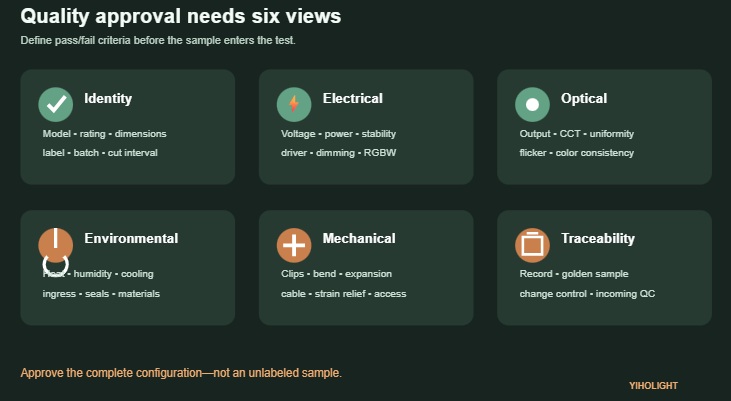
Create Pass/Fail Criteria Before Testing
Without written acceptance criteria, a sample evaluation becomes subjective. Agree on measurable or clearly observable requirements before the test begins.
A project scorecard might include:
Identity
Model, voltage, CCT, dimensions, and labeling match approval
Electrical
Stable operation at rated voltage and intended dimming range
Optical
No visible failed LEDs, objectionable flicker, or unacceptable color difference
Environmental
No moisture ingress, seal opening, or material damage after agreed cycle
Mechanical
Clips retain strip without crushing; cable has strain relief
Installation
Fits the approved detail and remains serviceable
Documentation
Test record links the result to a traceable sample and configuration
Define how many units or meters are tested, what constitutes a critical defect, and whether retesting is allowed after a configuration change.
Use the Approved Sample for Incoming Quality Control
Bulk-order control should not end when the purchase order is placed. Preserve a signed or clearly labeled reference sample. When production arrives, compare packaging, labels, dimensions, cable, seals, light color, power, and visual construction against that reference.
Incoming inspection can include a statistically appropriate sample from different cartons or reels. Test full output, dimming, and RGBW channels. Inspect cut marks and terminations. For repeat orders, monitor trends rather than only pass/fail results; a gradual shift in power or color may indicate a process or material change.
Do not substitute components without documented approval. A change in silicone, cable, connector, LED bin, resistor, or PCB can affect performance even when the exterior looks similar.
Yiholight supports OEM/ODM customization, including PCB dimensions, LED density, power options, packaging, branding, connectors, and control solutions. A detailed approval specification helps turn these options into repeatable production rather than one-off verbal requests.
Frequently Asked Questions
How long should a sauna LED strip burn-in test run?
There is no universal duration. Define a cycle based on project risk, operating pattern, product guidance, and applicable quality requirements. Record temperature, mounting, load, and pass/fail criteria so results are repeatable.
Is an IP rating enough to approve a sauna LED strip?
No. IP addresses ingress protection under defined conditions; it does not by itself confirm high-temperature performance, color stability, dimming, mechanical fit, or the quality of field terminations.
Should the sample be tested in a real sauna?
A real installation mock-up is valuable for appearance and system behavior, but controlled testing provides better measurement and repeatability. Higher-risk projects benefit from both.
Can one approved sample cover white and RGBW versions?
Not completely. They have different LED packages, widths, power, controls, connections, and cut intervals. Approve each configuration that will be ordered.
Turn Sample Approval into a Production Standard
Good sauna LED strip testing and quality control begin with a clear application brief and end with a traceable reference for incoming goods. Document review, baseline measurements, environmental cycling, and a full-size mock-up reveal different risks; none should be treated as a substitute for all the others.
Share your drawings, zone temperatures, control requirements, target quantity, and approval criteria with Yiholight. The team can recommend a suitable sauna LED strip configuration and prepare samples or project-specific lengths for evaluation before bulk production.
Learn more:
Why Sauna LED Strips Fail: 10 Problems, Causes, and Prevention Steps
Sauna & Steam Room LED Strip Lighting: Special Requirements You Must Know
How to Design Sauna LED Strip Lighting by Temperature Zone
Commercial Sauna Lighting for Hotels and Spas
As a bespoke lighting solution provider, Yiholight specializes in high-quality LED strips and neon flex. Our products are engineered for durability, brightness, and ease of installation—trusted by B2B customers across the globe.
Contact us today to explore the best LED lighting for your business!
© [Yiholight] and [www.yiholight.com]. Unauthorized use or duplication of this material is strictly prohibited without express written permission from the site’s author or owner. Excerpts and links may be used, provided full, clear credit is given to [Yiholight] and [www.yiholight.com], with appropriate, specific direction to the original content.