What Does Beam Angle Mean?
Beam angle normally describes the angular spread between the directions where intensity falls to 50% of the peak value. It is useful, but it is not a complete description of the beam. Two nominal 25° optics can have different peak intensity, field angle, edge softness, spill light and beam shape.
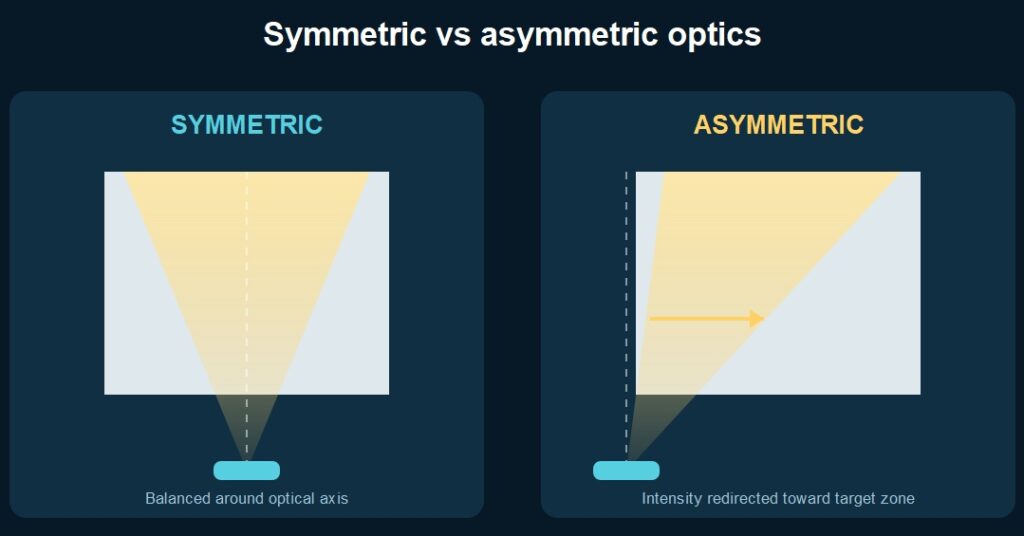
For a round or symmetric distribution, a single number such as 25° may be enough for a quick description. Elliptical and asymmetric distributions need two dimensions or a photometric diagram. An optic marked 20×55°, for example, distributes light more narrowly in one plane and more broadly in the other. Designers can use the narrow plane for vertical reach and the wide plane for horizontal blending, depending on product orientation.
Always confirm which plane each angle describes. The label alone does not show whether the wider axis runs along the wall or up the wall.
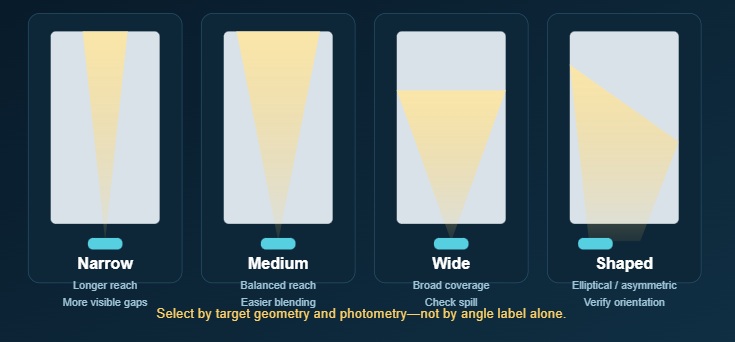
Narrow Beam Angles: Reach and Emphasis
Narrow beams—often around 10° to 25°, depending on the product family—concentrate light. They are useful when:
– the wall is tall and the luminaire must throw light over a longer distance
– a column, pier or narrow architectural feature needs emphasis
– the fixture is mounted relatively far from the target
– controlled highlights are intentional
– spill onto windows, paths or neighboring areas must be limited
The tradeoff is coverage. If narrow-beam luminaires are spaced too far apart, the wall can show bright columns, scallops or dark gaps. A narrow beam placed extremely close to a wall can also create a bright streak near the source while leaving the upper or lower area underlit.
Narrow does not automatically mean “better projection.” The result also depends on actual candela distribution, aiming, optical efficiency, lumen output and the surface reflectance. Compare IES or LDT files whenever the lighting must reach a defined height.
Medium Beam Angles: A Versatile Starting Point
Medium distributions, such as 25° or 35°, are common choices for façade bands, landscape walls and indoor feature walls. They balance useful reach with enough spread for adjacent beams to overlap.
A medium beam is often a practical starting point when the luminaire sits at a moderate setback and the design needs controlled illumination rather than a very broad ambient glow. It can also tolerate small installation variations better than an extremely narrow optic.
Yiholight’s flexible wall washer range includes symmetric-style and elliptical optical choices for different coverage patterns. This makes it possible to keep a flexible linear format while adapting the beam to different elevations and curves. Exact availability should be confirmed for the ordered profile, CCT, control type and project configuration on the Yiholight LED wall washer product page.
Wide and Elliptical Beams: Coverage and Blending
Wide beams spread light across more surface. They are valuable for low walls, close mounting positions, broad architectural elements and applications where smooth overlap matters more than maximum throw.
An elliptical beam can be especially efficient for a linear wall. Instead of wasting light above, below or away from the target, it can provide different spreads in the vertical and horizontal planes. A 20×55° distribution might be used to maintain some vertical control while widening the coverage along the wall, provided the optic is oriented correctly.
Potential disadvantages include lower peak intensity, more spill and a greater chance of glare if the source is visible. A wide beam cannot compensate for poor aiming or an unsuitable setback.
Start with the Desired Visual Effect
The first design question should be: what should the wall look like?
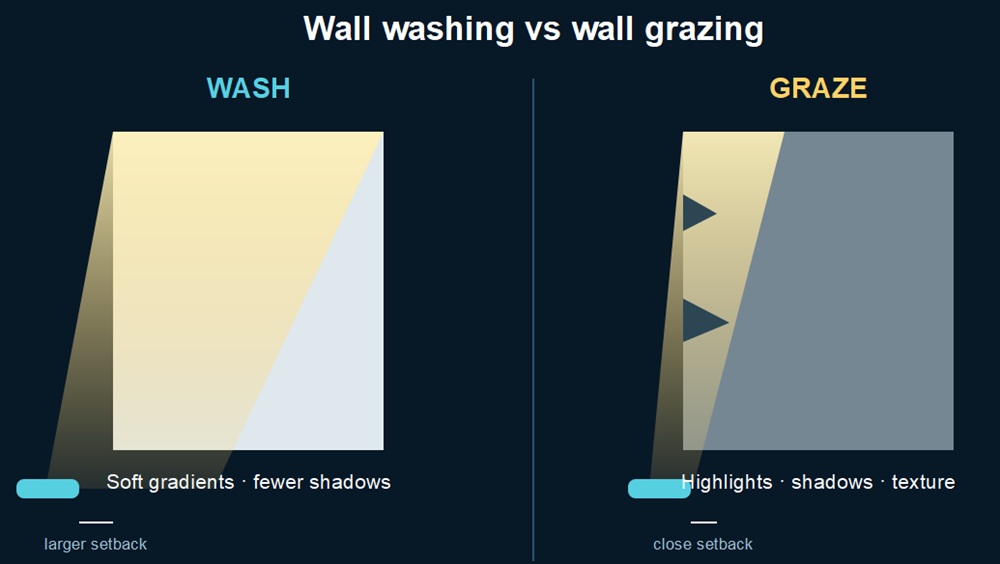
For smooth wall washing, select an optic and setback that allow the light to spread and blend. Smooth, matte walls, graphics, artwork and hospitality interiors usually benefit from controlled uniformity and soft transitions.
For wall grazing, position the luminaire closer to the surface and use a more directional distribution. Light arriving at a shallow angle creates small shadows that reveal stone, brick, timber or relief panels. The closer the light is to the wall, the stronger surface irregularities may appear.
The two techniques are not interchangeable. A beam chosen for dramatic texture may look streaky on a flat painted wall, while a broad wash may flatten the stonework a designer wanted to emphasize. Read our detailed comparison of wall washing and wall grazing before selecting an optic.
Match Beam Angle to Setback and Wall Height
Beam angle, setback and wall height form one system. Increasing setback gives the beam more distance to expand before it reaches the wall. Moving the luminaire closer reduces the footprint and makes aiming errors more visible.
A useful geometric estimate for a symmetric beam aimed perpendicular to a surface is:
> Beam width ≈ 2 × distance × tan(beam angle ÷ 2)
This calculation describes a theoretical cone at one distance. A wall washer is commonly tilted, its beam may not be symmetric, and usable illumination extends beyond the 50% beam boundary. Therefore, the formula is a planning aid—not a spacing rule or a substitute for photometric simulation.
For example, at a 1m throw distance, a theoretical 25° beam is about 0.44m wide at the 50% intensity boundary, while a 35° beam is about 0.63m wide. That does not mean fixtures should automatically be spaced at those dimensions. Adjacent distributions must overlap, and the required uniformity may call for closer spacing.
Consider the Wall Material and Color
A pale matte wall reflects more light diffusely than a dark surface. Dark brick, black stone or absorbent timber may need more delivered intensity to appear equally bright. Glossy stone, glass and glazed tile can reflect the luminaire or create distracting streaks even when measured illuminance is adequate.
Texture also changes the decision. Narrow directional light at a shallow angle produces deep micro-shadows. Wider light from a larger setback softens them. For mixed-material façades, one beam angle may not serve every zone.
A Practical Selection Standard
For tall, narrow feature, use narrow controlled beam , check gaps and excessive peak brightness.
For medium-height facade, use medium beam, check uniformity at top and bottom.
For low wall or close setback, use wider distribution, check spill and source glare.
For long linear wall, use elliptical or asymmetric beam, check correct lens orientation .
For rough stone or brick, use directional graze, check harsh shadows and installation tolerance.
For smooth graphic wall, use soft, overlapping wash, check scallops and visible color variation.
For curved facade, use flexible product with verified optic, check rotation changes beam direction.
Validate the Choice Before Ordering the Full Quantity
The most reliable workflow is to shortlist optics in software and confirm the result with a physical mock-up. Use the actual wall material or a representative sample. Install the wall washer at the intended setback, height, orientation and aiming angle. Evaluate it at night from normal viewing positions.
Check the top, middle and bottom of the wall; the joints between product lengths; inside and outside curves; reflections from glass; glare from pedestrian viewpoints; and brightness continuity between adjacent runs. Photographing the wall with locked camera exposure can make differences easier to compare, but visual review remains important.
Frequently Asked Questions
Is a 25° or 35° beam better for wall washing?
Neither is universally better. A 25° beam generally offers tighter control and higher concentration, while 35° provides broader coverage and easier blending. Setback, height and the actual photometric distribution decide which one performs better.
Does a wider beam always create better uniformity?
No. A wider beam can improve overlap, but it may also create spill, glare or insufficient intensity at the far end. Uniformity depends on distribution, aiming, distance, spacing and surface properties together.
Can beam angle predict throw distance?
It can support an estimate, but it cannot predict useful throw by itself. Candela distribution and the target illuminance are needed to evaluate reach.
Should I use asymmetric optics for a wall washer?
Asymmetric optics are useful when the luminaire is offset from the wall and the light needs to be redirected vertically or laterally. A symmetric optic may be suitable for centered accent features, grazing or installations where the fixture can be aimed precisely.
Final Recommendation
Choose an LED wall washer beam angle by working backward from the desired wall appearance. Define the visual effect, wall height, setback, surface and target brightness. Then compare verified photometric distributions—not just catalogue angle labels—and test the leading option on the real architecture.
For projects involving curves or irregular structures, share drawings, wall dimensions, surface information and installation limits with Yiholight so the flexible wall washer and optic can be evaluated for the actual project rather than selected in isolation.
Learn more:
Sauna & Steam Room LED Strip Lighting: Special Requirements You Must Know
LED Sauna Lights: What They Are, Why They Matter, and How to Use Them
How to Design Sauna LED Strip Lighting by Temperature Zone
Commercial Sauna Lighting for Hotels and Spas
As a bespoke lighting solution provider, Yiholight specializes in high-quality LED strips and neon flex. Our products are engineered for durability, brightness, and ease of installation—trusted by B2B customers across the globe.
Contact us today to explore the best LED lighting for your business!
© [Yiholight] and [www.yiholight.com]. Unauthorized use or duplication of this material is strictly prohibited without express written permission from the site’s author or owner. Excerpts and links may be used, provided full, clear credit is given to [Yiholight] and [www.yiholight.com], with appropriate, specific direction to the original content.