A Sauna Is a Temperature Gradient, Not a Single Temperature
The controller shows the temperature at its sensor. Upper walls are normally hotter than the space beneath the benches, while surfaces near the heater can experience intense local heat.
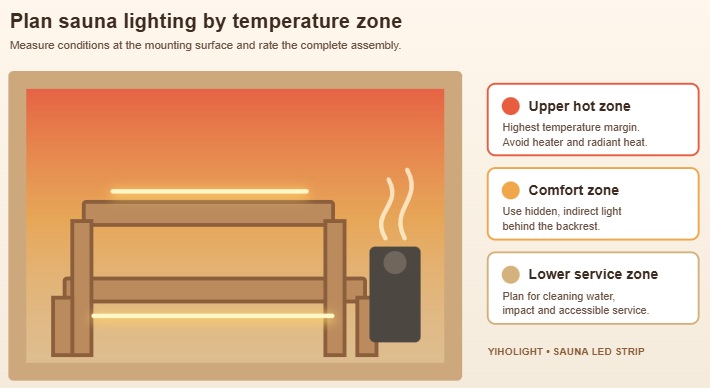
Before finalizing the lighting layout, identify three practical zones:
1. Upper hot zone: ceiling coves, upper wall details, and any location at or above head height. Components installed here need the greatest temperature margin. Keep LED strips away from the heater, flue, stones, and direct radiant heat.
2. Comfort zone: behind backrests and around the middle bench. This is usually the most useful location for soft indirect light because the source can be hidden while the timber reflects a warm glow.
3. Lower service zone: beneath benches, steps, and low wall details. Temperatures are often lower here, but cleaning water, condensation, and accidental contact become more important design considerations.
Record the expected operating temperature at the proposed mounting surface, not only at the thermostat. For an unfamiliar cabin, test temperatures under normal heater operation.
Start with the Complete Temperature Rating
A heat-resistant LED strip for sauna use is only one part of the system. The following items must also tolerate the conditions at their actual locations:
– silicone encapsulation or sleeve
– PCB, LEDs, resistors, and solder joints
– supply cable and cable entry
– connectors, end caps, and sealant
– clips, channels, and fasteners
– controller, dimmer, sensors, and LED driver
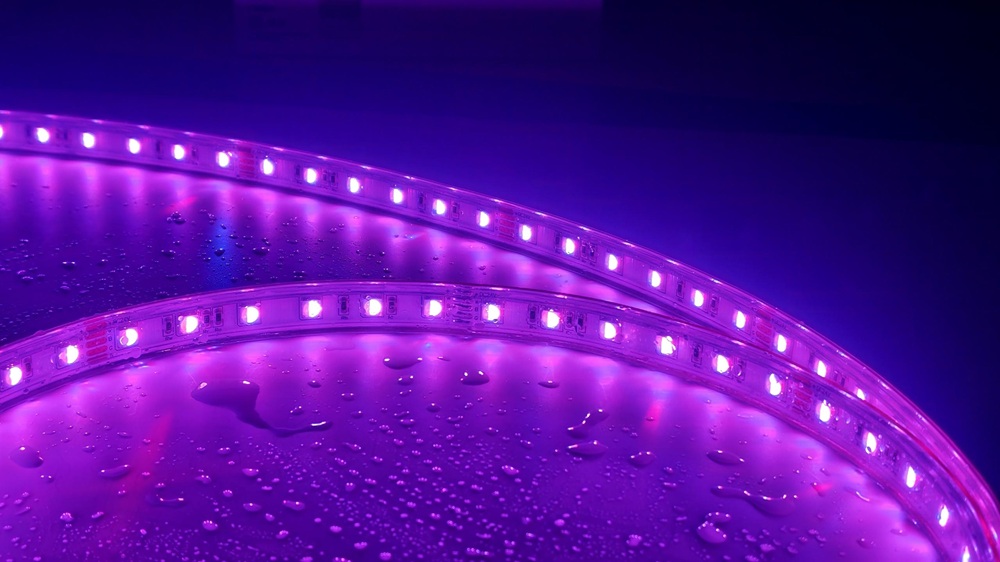
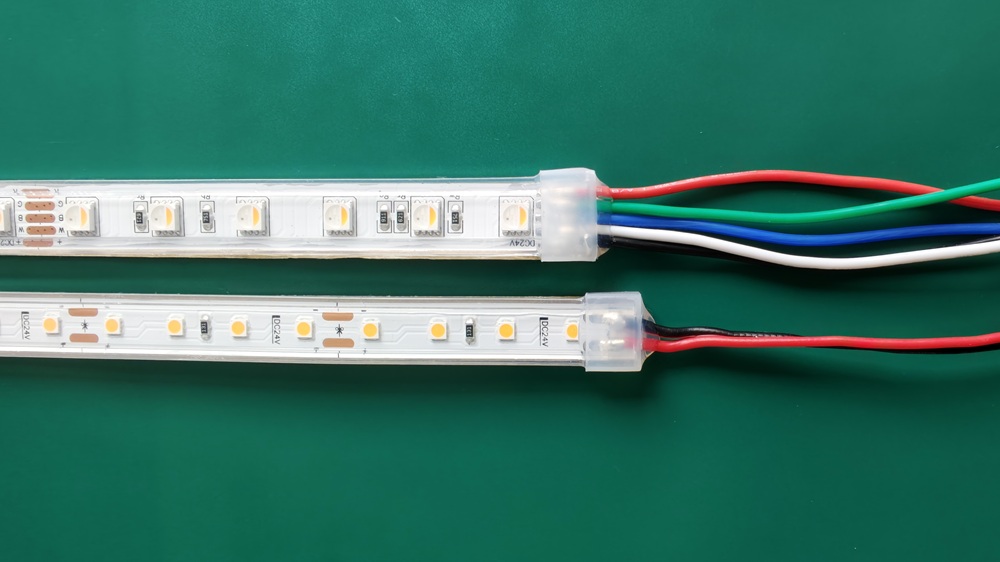
Yiholight’s sauna LED strip range is designed for high-temperature and high-humidity environments, with listed operation from -25°C to 100°C. The range includes 24V single-white and RGBW options for different project needs. However, a 100°C strip does not make every accessory in the installation a 100°C accessory. The lowest-rated component determines the practical limit of the assembly.
The power supply and controls should normally remain outside the chamber in a dry, ventilated, serviceable location.
Match Light Output to the Zone
More light is not always better inside a sauna. A bright exposed line at eye level can create glare and make a compact room feel less comfortable. Select output according to the job each layer performs.
Behind the Backrest
Backrest lighting should be indirect and visually quiet. Warm white between 2700K and 3000K complements sauna timber. The strip should wash the wall or backrest rather than point toward users.
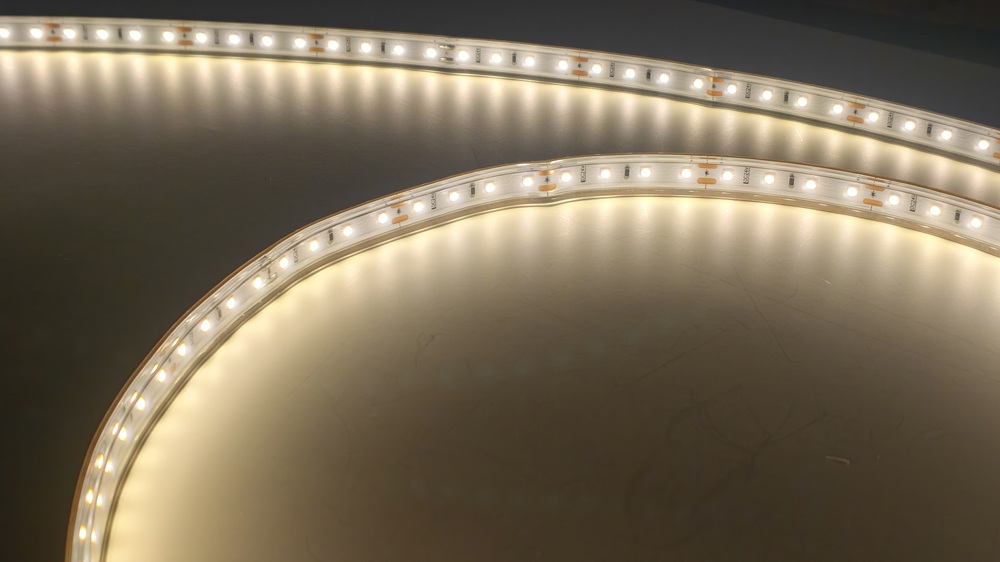
For subtle ambient lighting, Yiholight’s 24V, 4.8W/m white sauna strip (YH-DA30L80V2412-W) provides a lower-power option. Its published data includes 80 LEDs/m, IP65 protection, a 50mm cut size, and output up to 734lm/m, depending on the selected configuration and color temperature.
Under the Bench and Steps
Low-level light defines seat edges and changes in floor level. Use continuous, shielded runs and check the result from seated and standing positions; pale tile or glass can reveal otherwise hidden LEDs.
Ceiling and Architectural Details
Ceiling coves occupy the hottest part of the room. Use them only when measured temperatures, clearances, and the complete assembly are suitable. A backrest wash may deliver a similar effect with less thermal exposure.
Color-Changing Features
RGBW supports wellness scenes while retaining a dedicated white channel. Yiholight’s YH-DA50L60V2414-RGBW is a 24V, 14mm-wide option rated at 10W/m, with 60 LEDs/m, IP65, and a 100mm cut size. Use saturated color as a restrained accent.
Calculate the 24V System Before Installation
For each run, multiply strip length by power per meter:
Strip load (W) = length (m) × power (W/m)
For example, eight meters of 4.8W/m strip creates a 38.4W connected load. Eight meters of 9.6W/m strip creates a 76.8W load. The power supply must cover the total load with appropriate design headroom, while also following the driver’s loading and installation instructions.
A drawing should show every strip length, feed point, cable route, controller, and driver. Long runs can suffer voltage drop, seen as reduced brightness or color shift at the far end. Check the recommended run length and cable size; larger projects may require parallel feeds.
Never connect a low-voltage strip directly to an AC mains supply. Keep mains wiring, the LED driver, and any non-sauna-rated controls outside the chamber. Electrical work must follow local codes and be completed or checked by a qualified professional.
Treat Every Cut End as a Potential Entry Point
An IP rating applies to a correctly sealed product. After a waterproof strip is cut or joined, restore the connection to the required protection level.
Plan cut positions around the product’s cutting interval: 50mm for the listed YH-DA30L80V2412-W configurations and 100mm for the listed RGBW model. Avoid creating a field joint merely to correct a small measuring error. Where possible, order project-specific lengths and factory-prepared leads so fewer seals depend on site workmanship.
At every termination:
– use compatible end caps and heat-resistant sealant
– provide strain relief so cable movement does not stress the seal
– route cable to avoid low points where moisture can collect
– keep accessible connections outside the hottest or wettest zone
– allow the sealant to cure fully before heat and moisture testing
Waterproofing and heat resistance are separate requirements; a moisture-resistant connector may still fail at elevated temperature.
Use Mechanical Support in High Heat
Adhesive backing is convenient in normal interiors, but prolonged heat, timber movement, surface oils, and humidity can weaken an adhesive bond. A sauna installation should not rely on tape as its only support.
Use compatible mechanical clips, channels, or retention details. Fasteners must suit the substrate without puncturing the encapsulation. Allow for thermal expansion and respect the minimum bending radius.
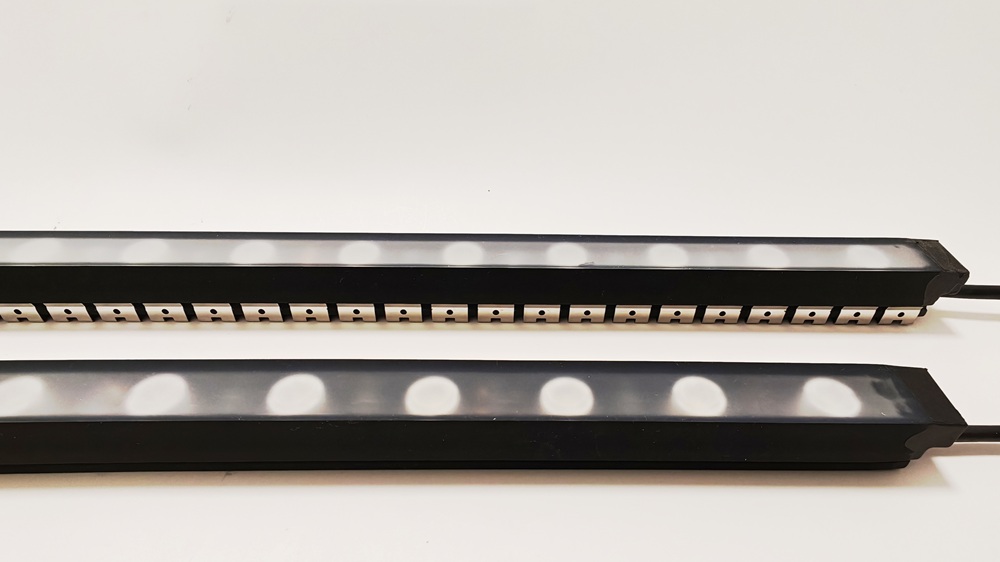
Channels require product-specific judgment. A suitable profile can protect the strip and refine the appearance, but an incompatible enclosed profile may trap heat. Confirm that the strip-and-profile assembly is approved for the measured zone rather than assuming every aluminum channel improves thermal performance.
Design for Commissioning and Service
Provide access to drivers, controllers, terminals, and strip leads without removing finished panels. Photograph cable routes before the timber lining is closed and label every circuit.
Commission the lighting in stages:
1. Test polarity, dimming, and color channels before installation.
2. Test each installed run before closing the joinery.
3. Operate the completed sauna through a normal heat cycle.
4. Inspect brightness, color consistency, seals, clips, and cable entries.
5. Recheck the system after cooling, when condensation may become visible.
Record the strip model, voltage, wattage, driver, controller, cut lengths, connection locations, and measured temperatures for future maintenance.
A Practical Specification Checklist
Before ordering **waterproof sauna LED strip** products, confirm:
– maximum measured ambient temperature for each lighting zone
– required IP protection and expected cleaning exposure
– white, RGBW, or another control requirement
– color temperature and brightness target
– 24V circuit load, cable size, and feed arrangement
– driver and controller location outside the sauna
– cut size, custom lengths, lead position, and cable length
– mounting hardware and substrate compatibility
– end sealing method and site responsibility
– samples or a mock-up for visual and thermal testing
Frequently Asked Questions
Can a regular waterproof LED strip be used in a sauna?
Not automatically. Waterproofing addresses moisture ingress; it does not prove that the LEDs, PCB, encapsulation, solder, cable, and connections can tolerate sauna temperatures. Use a strip specifically designed and rated for the measured environment.
Is IP65 enough for sauna LED strip lighting?
It depends on the location and exposure. A dry sauna zone with no direct spray has different requirements from a steam room or a floor-level area exposed to cleaning water. Select the protection level from the real application and local electrical requirements.
Where should the sauna LED driver be installed?
Place it outside the heated chamber in a dry, ventilated, accessible location, unless the complete equipment is explicitly rated and approved for another arrangement.
What color temperature works best?
Warm white at 2700K–3000K is a popular choice because it complements timber and creates a restful atmosphere. RGBW is useful when the project requires programmed color scenes plus a practical white channel.
Build the Lighting Around the Room, Not the Catalog
The best sauna lighting specification connects environmental data with visual intent. Temperature zoning identifies where the risk is highest; a coordinated 24V system manages power and voltage drop; sealed terminations protect against moisture; and serviceable construction reduces long-term maintenance.
Yiholight supplies sauna LED strip options for high-temperature projects, including single-white and RGBW configurations, custom lengths, connection solutions, and OEM/ODM support. Share your sauna dimensions, intended mounting positions, temperature data, and control requirements with the Yiholight team to develop a project-specific lighting solution.
Learn more:
Sauna & Steam Room LED Strip Lighting: Special Requirements You Must Know
Why Sauna LED Strips Fail: 10 Problems, Causes, and Prevention Steps
Best Sauna Light Colors: Warm White, Tunable White, or RGBW
Commercial Sauna Lighting for Hotels and Spas
As a bespoke lighting solution provider, Yiholight specializes in high-quality LED strips and neon flex. Our products are engineered for durability, brightness, and ease of installation—trusted by B2B customers across the globe.
Contact us today to explore the best LED lighting for your business!
© [Yiholight] and [www.yiholight.com]. Unauthorized use or duplication of this material is strictly prohibited without express written permission from the site’s author or owner. Excerpts and links may be used, provided full, clear credit is given to [Yiholight] and [www.yiholight.com], with appropriate, specific direction to the original content.