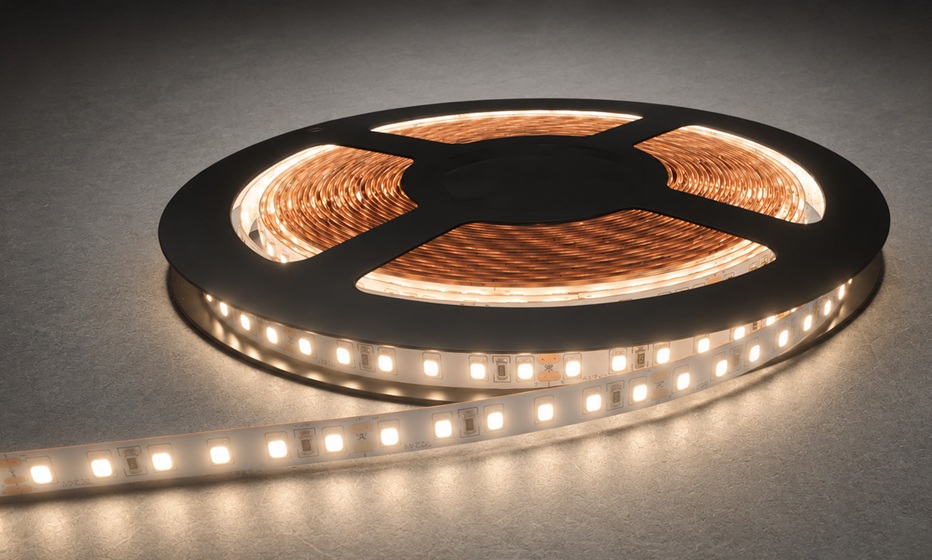
What Is a Full Spectrum LED Strip?
A Full Spectrum LED Strip is a flexible LED light strip designed to reproduce a broader and more balanced range of visible wavelengths than conventional white LEDs.
Typical white LEDs use a blue LED chip combined with phosphor material to produce white light.
This technology is efficient and widely used, but depending on the LED design, some parts of the visible spectrum may be stronger while others may be relatively weak.
A full spectrum LED aims to reduce these spectral gaps.
The goal is not simply to produce “white light.”
The goal is to create white light with a spectral distribution that more closely resembles natural daylight or another high-quality reference illuminant.
A well-designed full spectrum LED light strip can therefore provide:
- More natural color rendering
- Better red color reproduction
- More balanced color appearance
- Improved visual comfort
- Higher color fidelity
- More accurate representation of materials and finishes
For professional lighting projects, this makes full spectrum lighting particularly useful where visual quality matters more than simply achieving high lumen output.
Full Spectrum LED vs. Standard LED Strip
A conventional LED strip may perform perfectly well for general illumination.
For corridors, indirect lighting, decorative coves or basic commercial spaces, standard CRI 80 or CRI 90 LEDs may already provide a satisfactory result.
A full spectrum LED strip is intended for more demanding applications.
The difference becomes especially noticeable when illuminating objects with complex colors.
Examples include:
- Paintings
- Textiles
- Timber
- Leather
- Food
- Cosmetics
- Flowers
- Skin tones
- Luxury furniture
- Interior finishes
Under a basic light source, some colors can appear muted or slightly distorted.
Under a well-designed full spectrum source, these colors can appear richer and more natural because the light contains a more balanced distribution of wavelengths.
The difference is therefore not simply:
“Is the light bright enough?”
A better question is:
“Does the light reveal the object accurately?”
Is Full Spectrum the Same as High CRI?
Not exactly.
This is one of the most important distinctions when choosing professional LED lighting.
CRI, or Color Rendering Index, is a useful measurement of how accurately a light source renders colors compared with a reference source.
A CRI value of 90+ is generally considered good for many professional interior applications.
But two LED sources with similar CRI values can still have different spectral distributions.
This is why professional lighting evaluation increasingly looks beyond CRI alone.
A high-quality full spectrum LED strip may also provide excellent performance in:
- R9
- R1–R15
- TM-30 Rf
- TM-30 Rg
- Spectral Power Distribution
- Duv
- SDCM
These measurements help provide a more complete picture of light quality.
For example, the full spectrum LED strip referenced here achieves CRI above 97, TM-30 Rf above 95, Rg above 98 and R1–R15 values above 90, indicating strong overall color fidelity.
Comparable professional full-spectrum LED technologies can achieve typical CRI around 98, R1–R15 above 90 and TM-30 values around Rf 96 / Rg 99.
Why R9 Matters in High-Quality Lighting
CRI Ra is calculated using a group of standard test colors.
However, saturated red is not fully represented by the basic Ra calculation.
This is where R9 becomes important.
R9 measures how accurately a light source reproduces strong red tones.
Good red rendering matters in applications such as:
- Artwork
- Restaurants
- Food displays
- Fashion retail
- Cosmetics
- Wood interiors
- Skin tones
- Hospitality lighting
A light source can have a relatively high CRI while still providing weaker saturated-red performance.
For this reason, professional lighting buyers should not evaluate an LED strip based only on the CRI number printed on the specification sheet.
For color-critical applications, reviewing R9 and the complete R1–R15 data provides a more reliable picture.
What Are TM-30 Rf and Rg?
TM-30 provides a more detailed way to evaluate color quality.
Two important values are Rf and Rg.
Rf — Color Fidelity
Rf indicates how closely colors under the test light match colors under the reference source.
A higher Rf generally means higher color fidelity.
A value above 90 is already strong.
Full spectrum products designed for professional applications may achieve Rf above 95.
Rg — Color Gamut
Rg measures average color saturation.
A value close to 100 generally indicates that colors are rendered with a saturation level close to the reference source.
For example, an Rg around 98–102 suggests a balanced and natural color appearance rather than excessive desaturation or oversaturation.
This is why looking at CRI + R9 + Rf + Rg together is much more useful than relying on CRI alone.
How Close Is Full Spectrum LED to Natural Sunlight?
The term “full spectrum” is often used loosely in the lighting industry.
It does not mean an LED strip literally reproduces sunlight perfectly across every wavelength.
A better technical interpretation is that the LED spectrum is designed to be broader, smoother and more continuous, with fewer pronounced spectral gaps.
The reference full spectrum product reports more than 95% similarity between its visible spectrum and the solar spectrum.
That does not mean artificial LED light becomes identical to sunlight.
However, it indicates that spectral engineering has been used to provide a more natural distribution of visible wavelengths.
For professional buyers, the most reliable way to evaluate this is to request the actual Spectral Power Distribution, or SPD curve.
What Is an SPD Curve?
SPD stands for Spectral Power Distribution.
It shows how much optical energy a light source produces at different wavelengths.
Visible light is typically evaluated approximately between:
380nm and 780nm
Instead of reducing light quality to one number, an SPD graph allows lighting designers and engineers to see how the spectral energy is distributed.
A conventional phosphor-based LED may show:
- A strong blue peak
- A broader phosphor-generated region
- Different energy levels across green, yellow and red wavelengths
A full spectrum LED is designed to create a more balanced profile.
For demanding projects, numerical SPD data can be even more valuable than a simple graph because it allows engineers or testing laboratories to perform their own analysis.
Where Is Full Spectrum LED Strip Most Useful?
Art Galleries and Museums
Artwork is one of the clearest applications for full spectrum LED lighting.
Paintings can contain subtle combinations of reds, greens, blues, earth tones and pigments that respond differently depending on the spectral quality of the light.
A high-fidelity light source can help visitors see these colors more naturally.
For galleries and private art collections, other factors may also be important, including:
- UV and near-UV output
- Blue-light spectral distribution
- Heat
- Dimming quality
- Flicker
- Long-term color consistency
This means a professional full spectrum LED strip for artwork should be evaluated using both color quality and spectral data.
Luxury Residential Interiors
Premium interior design relies heavily on material quality.
Natural stone, timber, leather, artwork, fabrics and decorative surfaces can all look different depending on the lighting spectrum.
A CRI 97+ full spectrum LED strip helps these materials retain a more natural visual appearance.
It is therefore especially suitable for:
- High-end homes
- Villas
- Luxury apartments
- Wardrobes
- Wine cabinets
- Decorative shelving
- Architectural coves
Retail and Product Displays
In retail environments, lighting can directly influence how customers perceive products.
Fashion requires accurate reproduction of fabric colors.
Cosmetics require natural skin tones.
Food should appear fresh.
Furniture needs accurate reproduction of wood, leather and textiles.
For premium retail displays, a high CRI full spectrum LED strip can help products appear closer to their true colors.
Photography and Video
Photographers and videographers need predictable color.
Poor spectral quality can cause certain colors to reproduce incorrectly on camera even when the lighting looks acceptable to the eye.
Full spectrum LED strips with strong color fidelity can therefore be useful for:
- Studios
- Product photography
- Video production
- Display photography
- Content creation
- Makeup lighting
For professional camera applications, TLCI and spectral data may also be useful evaluation criteria.
Hospitality Lighting
Hotels, restaurants, spas and premium commercial interiors depend heavily on atmosphere.
Warm light alone does not guarantee good visual quality.
A 2700K full spectrum source can combine a warm atmosphere with strong color reproduction.
This allows food, wood, fabrics and skin tones to remain natural while maintaining a comfortable warm-light environment.
Architectural Lighting
Linear lighting is frequently integrated into:
- Ceiling coves
- Wall details
- Shelving
- Recessed profiles
- Furniture
- Handrails
- Decorative structures
Using a full spectrum flexible LED strip allows designers to combine high-quality color rendering with the installation flexibility of conventional LED tape.
Choosing the Right Color Temperature
Full spectrum does not mean one specific CCT.
Professional full spectrum LED strips can be produced across multiple color temperatures.
The reference series offers options including 2700K, 3000K, 3500K, 4000K, 5000K and higher-CCT configurations, depending on the model.
2700K
Warm and comfortable.
Suitable for:
- Hotels
- Restaurants
- Luxury homes
- Bedrooms
- Warm interior materials
3000K
Warm but slightly cleaner than 2700K.
Widely used for:
- Residential interiors
- Galleries
- Hospitality
- Furniture lighting
- Premium retail
4000K
Neutral white with excellent visual clarity.
Suitable for:
- Galleries
- Retail
- Offices
- Studios
- Showrooms
- Product displays
The best CCT depends on both the application and the materials being illuminated.
Color Consistency Is Just as Important as CRI
High color rendering means little if different sections of an installation have visibly different white tones.
This is why SDCM, or Standard Deviation Color Matching, is important.
For professional architectural projects, SDCM ≤3 is commonly preferred.
More demanding projects may specify SDCM ≤2.
Tighter color binning helps ensure consistency:
- Between reels
- Between production batches
- Across long installations
- Between replacement products
Professional high-color-quality LED technologies often specify tight MacAdam binning, such as less than 3-step variation.
For lighting brands and project contractors, this becomes especially important when future replacement consistency is required.
Does Full Spectrum LED Strip Produce UV?
This should not be assumed either way.
The visible-light spectrum usually covers roughly 380–780nm.
UV sits below the visible spectrum.
For applications involving artwork, museum objects or sensitive materials, buyers should request actual test data rather than simply relying on the term “full spectrum.”
Important information can include:
- SPD data from 380–780nm
- Quantified output below 400nm
- Excitation or blue-pump peak wavelength
- UV / near-UV output
- Blue spectral energy
This is particularly important because “full spectrum” describes the spectral design philosophy, not automatically the level of UV radiation.
For artwork and conservation-focused projects, measured spectral data should always take priority over marketing terminology.
What Specifications Should Professional Buyers Request?
When sourcing a professional full spectrum LED strip, consider requesting more than a basic datasheet.
A useful evaluation package may include:
- CRI Ra
- R1–R15
- R9
- TM-30 Rf
- TM-30 Rg
- CCT
- Duv
- SDCM
- SPD graph
- Numerical SPD data
- Blue-pump peak wavelength
- UV / near-UV information
- LM-80 data where available
- IES photometric files
- Electrical specifications
- Luminous efficacy
This allows the product to be evaluated from both a visual and engineering perspective.
Typical Full Spectrum LED Strip Configuration
A professional full spectrum flexible LED strip may use specifications such as:
- DC24V
- 10mm PCB
- 120 LEDs/m
- Multiple CCT options
- High CRI
- High TM-30 fidelity
- Short cutting intervals
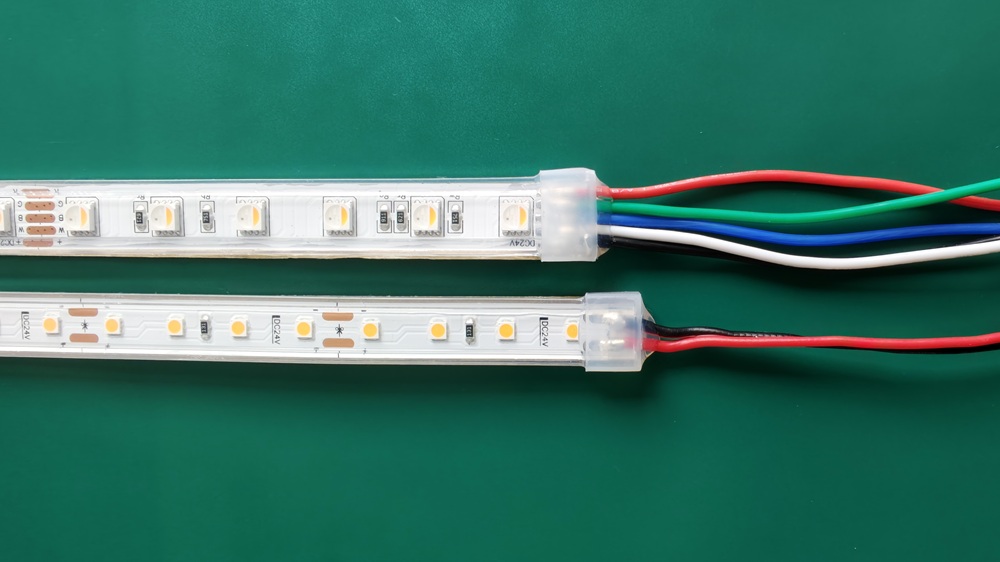
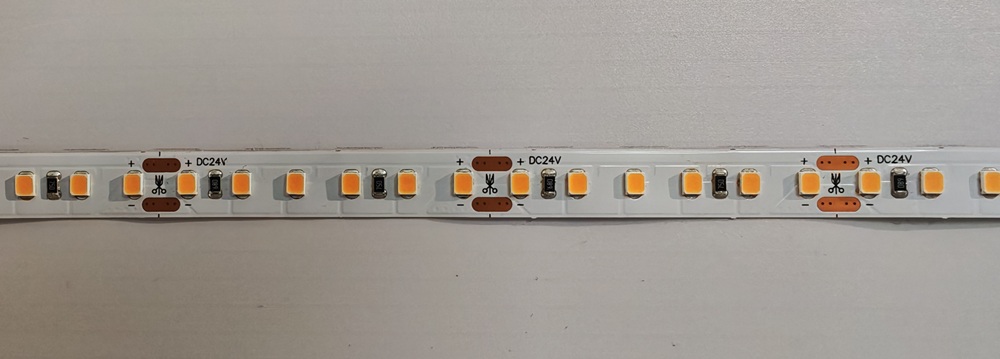
The reference full spectrum strip uses DC24V, 10mm PCB and 120 LEDs per meter, with a 50mm minimum cutting unit.
However, the best specification should always be selected according to the application rather than choosing the highest possible number in every category.
Full Spectrum LED Strip vs. High CRI LED Strip: Which Should You Choose?
A high-CRI LED strip is an excellent solution for many applications.
You do not necessarily need full spectrum technology everywhere.
Choose a standard CRI 90+ strip when:
- General visual quality is sufficient
- Cost efficiency matters more
- The application is mainly indirect lighting
- Color accuracy is not mission-critical
Consider a full spectrum CRI 97+ LED strip when:
- Artwork is being illuminated
- Materials need accurate color reproduction
- Retail products need natural presentation
- Photography or video is involved
- High-end interior visual quality is important
- Detailed spectral performance is specified
The correct solution depends on the visual objective.
Full Spectrum Lighting Is About More Than a CRI Number
It is easy to market a lighting product with one impressive number.
CRI 95.
CRI 97.
CRI 98.
But professional light quality is more complex.
The best evaluation considers the complete system:
Spectrum + CRI + R9 + TM-30 + color consistency + application requirements.
This is where full spectrum lighting becomes valuable.
Rather than focusing only on how efficiently an LED produces white light, a full spectrum solution focuses on how naturally that light reveals the world around it.
For artwork, premium materials, products, food and interior environments, this can create a noticeable improvement in visual quality.
Looking for a Full Spectrum LED Strip for Your Project?
If your project requires high color fidelity, natural light quality or more detailed spectral control, YIHOLIGHT can help evaluate the appropriate full spectrum LED strip solution.
For professional projects, we can work around requirements such as:
- 2700K / 3000K / 4000K and other CCTs
- CRI 97+ or higher
- High R9
- TM-30 Rf / Rg
- Tight SDCM binning
- SPD testing
- Custom PCB and electrical configurations
- OEM and private-label requirements
For artwork, galleries and high-value interiors, we also recommend evaluating SPD data and output below 400nm rather than relying only on CRI.
Send us your required CCT, dimensions, target color-quality specifications and application details.
We can help identify a suitable solution for testing and project evaluation.
Learn more:
CRI, SDCM & Color Binning Explained
How Warm Light Transforms Wooden Spaces
How to Choose LED Strip Lights for Commercial Projects
As a bespoke lighting solution provider, Yiholight specializes in high-quality LED strips and neon flex. Our products are engineered for durability, brightness, and ease of installation—trusted by B2B customers across the globe.
Contact us today to explore the best LED lighting for your business!
© [Yiholight] and [www.yiholight.com]. Unauthorized use or duplication of this material is strictly prohibited without express written permission from the site’s author or owner. Excerpts and links may be used, provided full, clear credit is given to [Yiholight] and [www.yiholight.com], with appropriate, specific direction to the original content.