Traditional RGB LED strips can change color.
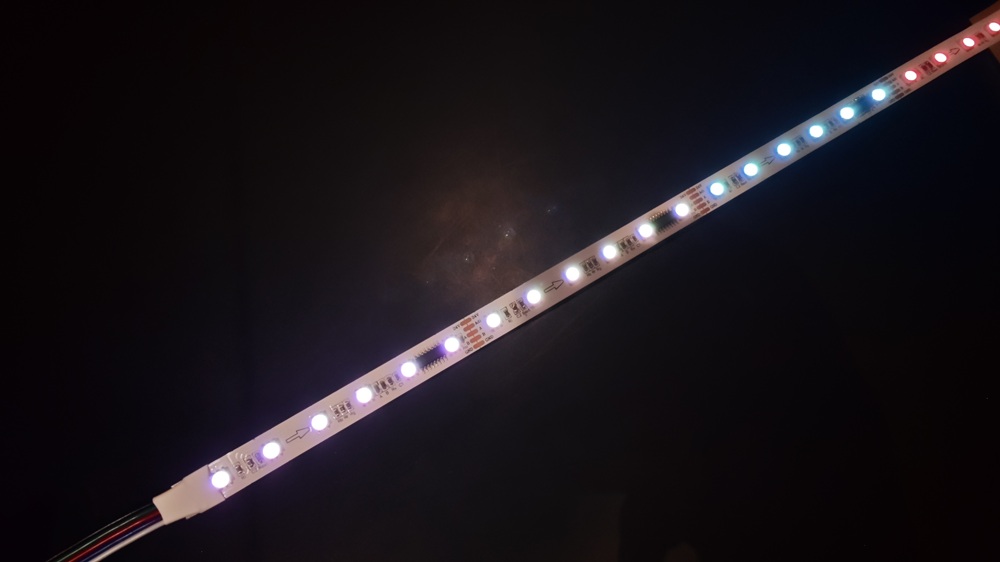
Digital RGB LED strips can make the color move.
That is the fundamental difference.
With a conventional RGB strip, the entire connected section normally displays the same color at the same time. A digital LED strip, also known as an addressable LED strip, pixel LED strip, or programmable LED strip, divides the lighting into individually controllable LEDs or segments.
This allows designers to create effects such as:
Chasing
Flowing light
Running effects
Gradients
Sequential lighting
Flashing
Customized animations
Multi-color patterns
For architectural facades, entertainment venues, signage, retail displays, stages and interactive installations, digital RGB and RGBW LED strips provide much more creative control than standard RGB lighting.
Table of Contents
What Is a Digital RGB LED Strip?
A Digital RGB LED Strip is a flexible LED strip that combines RGB LEDs with integrated control ICs.
The IC receives digital data from a compatible controller and determines what color each pixel or controllable segment should display.
This is different from a conventional RGB LED strip.
With traditional RGB:
One connected section = one color at a time
With digital RGB:
Different pixels or segments = different colors at the same time
For example, one strip can simultaneously display:
Red → Orange → Yellow → Green → Blue
The colors can then move along the strip to create a flowing or chasing effect.
This is why digital strips are widely used in applications where lighting needs to become part of the visual experience rather than simply provide illumination.
Addressable LED Strip, Pixel LED Strip and Digital LED Strip: Are They the Same?
These terms are often used interchangeably.
In most projects:
Digital LED Strip refers to a strip controlled by digital signals.
Addressable LED Strip emphasizes that individual LEDs or groups can be addressed separately.
Pixel LED Strip describes the strip according to its controllable lighting units.
Programmable LED Strip emphasizes that lighting effects can be created through a controller or software.
Although the terminology may vary between manufacturers, the main idea is the same:
The strip supports independent control of multiple lighting zones.
However, buyers should always confirm the actual pixel definition.
One pixel may represent:
One LED
Three LEDs
Six LEDs
Another group size
The pixel configuration directly affects animation smoothness, cutting length and controller capacity.
Digital RGB vs Traditional RGB LED Strip
The biggest difference is control.
A traditional RGB strip typically uses four electrical connections:
Positive
Red
Green
Blue
The controller changes the intensity of the RGB channels across the entire connected section.
A digital RGB strip also carries control data.
The ICs along the strip interpret this data and control individual pixels.
This enables effects that standard RGB strips cannot create.
Traditional RGB Is Better When:
Only static color changes are required
The complete strip can display the same color
Simple dimming is enough
Lower control complexity is preferred
Cost is a major consideration
Digital RGB Is Better When:
Chasing effects are required
Multiple colors must appear simultaneously
Lighting needs to move
Custom animations are required
Different sections need independent control
The correct product depends on the visual objective.
Digital technology is not automatically necessary for every RGB project.
What Is a Digital RGBW LED Strip?
An RGBW Pixel LED Strip adds a dedicated white LED channel to the red, green and blue channels.
This creates four controllable channels:
R + G + B + W
RGB can create a form of white by combining red, green and blue.
However, this mixed white is not always ideal when the project also requires practical white illumination.
A dedicated white channel provides a more useful white-light option.
This makes Digital RGBW LED Strip particularly suitable for projects that need both:
Dynamic colorful effects
Functional white illumination
Typical applications include:
Hotels
Restaurants
Retail environments
Entertainment spaces
Architectural features
Signage
Exhibition displays
During normal operation, the system can provide white light.
For events or decorative scenes, it can switch to dynamic RGB effects.
This dual function is one of the strongest reasons to choose RGBW instead of RGB.
Digital White LED Strip: Dynamic Effects Without RGB
Digital lighting does not always need color.
A Digital White LED Strip uses individually controllable white LED segments to create movement while maintaining a single white-light color.
Instead of rainbow effects, it can produce:
White chasing
Sequential illumination
Flowing white light
Running effects
Pulsing patterns
This can be useful in projects where colorful RGB lighting would be inappropriate but movement is still required.
Examples include:
Architectural lines
KTV interiors
Gaming rooms
Stages
Entertainment installations
Decorative commercial lighting
Digital white strips can therefore create animation while maintaining a cleaner visual style.
SPI vs DMX Digital LED Strip
One of the most important decisions when selecting a digital LED strip is the control protocol.
Two common approaches are SPI and DMX.
SPI LED Strip
SPI-controlled strips are widely used for pixel lighting.
They use a digital signal that passes through ICs along the strip.
SPI solutions are popular because they can provide:
High pixel density
Smooth chasing effects
Flexible programming
Compact control architecture
A wide choice of ICs
Typical IC families may include products such as:
WS2811
WS2815
UCS1903
UCS2904
GS8206
Different ICs have different voltage, pixel, redundancy and control characteristics.
Therefore, the IC should be selected according to the complete project rather than simply choosing the most familiar model.
DMX LED Strip
DMX is commonly used in professional architectural and entertainment lighting.
A DMX digital LED strip is particularly useful when the strip needs to integrate with a larger lighting-control system.
It may be preferred for:
Architectural façades
Hotels
Stage projects
Commercial lighting systems
Large synchronized installations
YIHOLIGHT’s digital RGB range includes both SPI-based configurations and DMX-compatible models, including solutions using UCS512C4 for professional control applications.
Why Pixel Density Matters
Pixel density determines how many individually controllable zones exist along the strip.
More pixels generally allow smoother animation.
For example:
A strip with only a few pixels per meter may create visible jumps during a chasing effect.
A strip with more pixels can create smoother movement.
However, more pixels also increase:
Controller load
Data requirements
Programming complexity
System cost
Therefore, the highest pixel density is not always the best choice.
A large building façade viewed from 30 meters away may not need the same pixel density as a small retail display viewed from 1 meter away.
Pixel density should match:
Viewing distance + animation requirement + controller capacity + budget
5050 vs 2835 Digital RGB LED Strip
Digital RGB strips can also use different LED packages.
Two useful examples are SMD5050 and SMD2835.
SMD5050 Digital RGB
5050 is one of the most widely used packages for RGB and RGBW pixel strips.
It provides:
Strong color output
Good RGB mixing
Familiar industry architecture
Broad IC compatibility
It is particularly suitable for:
Stage lighting
Entertainment
Media façades
Signage
Creative installations
For projects where color intensity and visual impact are the priority, 5050 remains a practical solution.
SMD2835 Digital RGB
2835-based digital strips can be useful when efficiency and thermal performance are more important.
They can offer:
Lower power consumption
Good efficiency
Stable continuous operation
Compact PCB options
This can make them attractive for:
Architectural lighting
Commercial projects
Long installations
Applications requiring better energy efficiency
The LED package should therefore be selected according to the project rather than assuming all digital RGB strips are the same.
12V vs 24V Digital LED Strip
Voltage is another important selection factor.
12V Digital LED Strip
12V can work well for:
Shorter runs
Smaller pixel projects
Compact installations
Certain addressable IC architectures
24V Digital LED Strip
24V is often preferred for longer professional installations.
Benefits can include:
Lower current for the same power
Better voltage-drop performance
Longer practical run lengths
Easier power distribution
For architectural and commercial projects, 24V is often a useful starting point, but the final choice depends on pixel architecture and strip design.
Where Are Digital RGB and RGBW LED Strips Used?
1. Building Facade Lighting
Dynamic pixel strips can turn architectural lines into programmable visual features.
They can create:
Color movement
Sequential effects
Animated outlines
Holiday scenes
Brand-specific effects
Digital strips are particularly useful on commercial buildings, hotels and entertainment architecture where lighting forms part of the nighttime identity.
2. Stage and Entertainment Lighting
Stages, KTVs, clubs and gaming environments often require movement rather than static color.
Pixel strips can synchronize with controllers to create fast-moving effects and immersive environments.
Applications include:
Stage edges
Ceiling features
Wall graphics
Bars
Gaming rooms
DJ booths
3. Media and Interactive Installations
When multiple pixels are arranged across a structure, the LEDs can begin to function like a low-resolution media surface.
Designers can create:
Animated patterns
Moving gradients
Graphic effects
Interactive lighting sequences
This is useful for:
Media façades
Art installations
Brand experiences
Exhibition structures
Public-space lighting
4. Signage
Digital RGB strips can make signs more noticeable.
Instead of a static illuminated logo, designers can create:
Running outlines
Color transitions
Sequential letters
Animated brand effects
For curved signs, digital technology can also be combined with S-shape LED strip structures.
5. Retail Displays
Retail environments increasingly use movement to attract attention.
Pixel LED strips can be integrated into:
Shelving
Product displays
Brand walls
Window displays
Launch installations
RGBW versions are especially useful because the same fixture can provide white lighting during normal operation and dynamic color during promotional events.
6. Exhibitions and Events
Temporary installations often need strong visual impact.
Digital LED strips provide a lightweight and flexible way to create animated features without using large rigid displays.
They can be integrated into:
Booths
Product-launch stages
Logo walls
Temporary structures
Decorative frames
What Should You Check Before Choosing a Digital LED Strip?
Professional buyers should not select a digital strip only by looking at LED quantity.
Several specifications need to work together.
IC Type
Confirm which control IC is used.
The controller must be compatible with the IC protocol.
Pixel Quantity
Check the number of controllable pixels per meter.
Do not confuse LED quantity with pixel quantity.
Voltage
Choose between 12V and 24V according to run length, power and control architecture.
RGB or RGBW
Choose RGB for primarily colorful effects.
Choose RGBW when functional white light is also required.
PCB Width
PCB width affects installation space and heat dissipation.
Cutting Unit
The cutting interval is often linked to the pixel architecture.
Higher pixel density often enables shorter controllable and cutting sections.
Waterproofing
Indoor installations may use IP20.
Outdoor projects may require additional waterproof construction depending on the environment.
Controller Capacity
The controller must support:
The IC protocol
Required pixel quantity
Number of output channels
Programming method
Controller selection should therefore happen at the same time as strip selection.
A Digital LED Strip Is a System, Not Just a Product
This is one of the most important points in digital lighting.
A conventional white LED strip can often be selected mainly by:
Voltage
Power
CCT
CRI
A digital LED strip requires a broader system approach.
The complete solution may include:
LED Strip + IC + Controller + Power Supply + Signal Wiring + Software / Programming
If one part is incompatible, the system may not work correctly.
For professional projects, the strip should therefore be selected together with the control system.
Custom Digital LED Strip Solutions
Different applications require different configurations.
YIHOLIGHT’s digital RGB and RGBW series can be customized around factors such as:
LED package
LED density
Pixel quantity
IC type
SPI or DMX control
Voltage
PCB width
RGB or RGBW
Waterproofing
Connectors
Cable lengths
Controller compatibility
For OEM and project customers, this flexibility is particularly important because the right digital strip depends heavily on the final visual effect and control architecture.
From Color Changing to Programmable Lighting
The biggest difference between traditional RGB and digital RGB is not simply the number of colors.
Both can create millions of RGB color combinations.
The real difference is where those colors can appear and how they can move.
Traditional RGB controls the strip as one lighting zone.
Digital RGB turns the strip into a sequence of controllable pixels.
That enables:
Color + Position + Movement + Timing
Once those four elements can be programmed, the LED strip becomes more than a decorative light source.
It becomes a programmable visual medium.
Looking for a Digital RGB or RGBW LED Strip Solution?
If your project requires chasing, flowing, gradient, running or programmable lighting effects, YIHOLIGHT can help evaluate the appropriate digital LED strip and control system.
Our solution range includes:
Digital White LED Strip
Digital RGB LED Strip
Digital RGBW LED Strip
SPI Pixel LED Strip
DMX LED Strip
2835 and 5050 options
12V and 24V configurations
Multiple IC protocols
Customized pixel density
Controller and system matching
Send us your required lighting effect, installation length, voltage, pixel density and control method.
We can help select the appropriate LED strip, IC, controller and power configuration for your project.
YIHOLIGHT — Programmable Linear Lighting Solutions for Dynamic Applications
Other articles:
S Shape SPI RGB LED Strip: A Flexible Pixel Lighting Solution for Creative Displays
LED Strip Specs Explained: What Really Matters
LED Strip Lighting for Signage & Light Boxes: A Complete Guide for Buyers
👉Explore Addressable LED Strip
As a bespoke lighting solution provider, Yiholight specializes in high-quality LED strips and neon flex lights. Our products are engineered for durability, brightness, and ease of installation—trusted by B2B customers across the globe.
Contact us today to explore the best LED lighting for your business!
© [Yiholight] and [www.yiholight.com]. Unauthorized use or duplication of this material is strictly prohibited without express written permission from the site’s author or owner. Excerpts and links may be used, provided full, clear credit is given to [Yiholight] and [www.yiholight.com], with appropriate, specific direction to the original content.