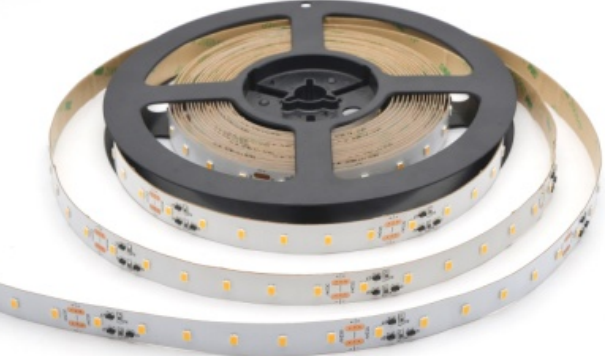
LED strip lights have become one of the most widely used lighting solutions in modern residential, commercial, and architectural projects. Their slim profile, flexible PCB design, and low-voltage operation make them suitable for applications where traditional fixtures are difficult to install.
From kitchen cabinets and furniture lighting to retail displays, hotel coves, and outdoor facades, LED strips offer flexible installation and efficient illumination across a wide range of environments.
However, choosing the right LED strip is not always straightforward.
Different factors—including LED chip type, voltage, LED density, color temperature, CRI, waterproof rating, and installation method—directly affect performance, durability, and lighting quality.
This guide explains how LED strip lights work, the major product types available, and how to choose the right strip based on real application needs.
Table of Contents
What Are LED Strip Lights?
LED strip lights (also called LED tape lights or LED ribbon lights) are flexible circuit boards mounted with LED chips that provide continuous linear illumination.
A typical LED strip includes:
- LED chips (light source)
- Flexible printed circuit board (PCB)
- Current-regulating resistors or IC drivers
- Adhesive backing
- Copper traces for power transmission
Most LED strips can be cut at designated intervals and reconnected using soldering or connectors.
Their flexibility allows installation in:
- ceilings
- cabinets
- shelves
- walls
- furniture
- signage
This makes them one of the most adaptable lighting systems in modern design.
Types of LED Strip Lights
Different LED strip types serve different purposes.
SMD LED Strip Lights
SMD strips use individual LED chips mounted directly onto the PCB.
Common chip types:
2835 LED Strips
Best for:
- high efficiency
- general lighting
- long operating hours
Advantages:
- better lumen efficiency
- lower heat generation
3528 LED Strips
Best for:
- decorative lighting
- low-power projects
Advantages:
- lower cost
- basic ambient lighting
5050 LED Strips
Best for:
- RGB lighting
- brighter applications
Advantages:
- larger chip size
- stronger brightness output
COB LED Strip Lights
COB (Chip on Board) strips place hundreds of LED chips closely together, creating a smooth and dot-free line of light.
Best for:
- visible installations
- furniture lighting
- under-cabinet lighting
- premium architectural projects
Choose COB if visual continuity is important.
Neon Flex LED Strips
Neon flex combines LED strips with silicone diffusers to create continuous neon-like lighting.
Best for:
- signage
- outdoor facades
- architectural outlines
Advantages:
- waterproof protection
- UV resistance
- soft light diffusion
How to Choose Between COB and SMD LED Strips
This is one of the most common questions.
Choose COB if:
- the strip will be directly visible
- hotspot-free lighting is required
- premium appearance matters
Choose SMD if:
- budget is important
- indirect lighting is sufficient
- higher lumen output is required
Quick rule:
COB = smoother appearance
SMD = higher flexibility and lower cost.
12V vs 24V LED Strip Lights
Voltage affects installation length and stability.
12V LED Strips
Best for:
- short installations
- small furniture projects
- tighter cutting intervals
Advantages:
- easier customization
- more cut points
Limitations:
- more voltage drop on long runs
24V LED Strips
Best for:
- long linear runs
- commercial projects
- architectural lighting
Advantages:
- reduced voltage drop
- better brightness consistency
- higher system stability
For most professional installations, 24V is preferred.
LED Density and Brightness
LED density refers to the number of LEDs per meter.
Common options:
- 60 LEDs/m → basic decorative lighting
- 120 LEDs/m → balanced lighting
- 240 LEDs/m → premium smooth lighting
Higher density improves:
- uniformity
- hotspot reduction
- visual smoothness
Brightness is measured in lumens per meter (lm/m).
Typical ranges:
- 300–600 lm/m → decorative
- 600–1200 lm/m → ambient
- 1200–2000 lm/m → task lighting
Choose based on visibility and lighting purpose.
Color Temperature and CRI
Color temperature affects mood and visual comfort.
Warm White (2700K–3000K)
Best for:
- homes
- restaurants
- hospitality
Neutral White (3500K–4000K)
Best for:
- offices
- retail spaces
- kitchens
Cool White (5000K–6500K)
Best for:
- workspaces
- industrial lighting
CRI (Color Rendering Index)
CRI is often overlooked but critical.
Recommended:
- CRI 80+ for general use
- CRI 90+ for furniture, kitchens, retail, and hospitality
Higher CRI improves:
- wood tones
- food appearance
- product color accuracy
Waterproof Ratings (IP Ratings)
IP rating determines environmental protection.
IP20
Indoor dry environments only.
IP65
Splash-resistant.
Best for:
- kitchens
- bathrooms
IP67 / IP68
Suitable for:
- outdoor use
- wet environments
- architectural facade lighting
Choosing the wrong IP rating is a common cause of failure.
Installation Methods
Adhesive Mounting
Best for quick indoor installation.
Risk:
adhesive may fail under heat.
Aluminum Profiles
Recommended for:
- high-power strips
- premium projects
- long-term stability
Benefits:
- heat dissipation
- cleaner appearance
- diffuser compatibility
Mounting Clips
Best for:
- outdoor use
- uneven surfaces
Provides stronger mechanical stability.
Common Mistakes When Buying LED Strip Lights
Choosing only by price
Cheap strips often use:
- thin PCB
- poor copper quality
- inconsistent LEDs
Ignoring heat management
Heat buildup reduces lifespan significantly.
Using the wrong voltage
Long 12V runs often cause brightness drop.
Ignoring CRI
Low CRI affects visual quality more than many buyers realize.
Using incorrect IP ratings
Moisture damage is one of the most common field failures.
Best LED Strip Lights for Different Applications
Kitchen Cabinets
Best choice:
COB + 24V + CRI 90+
Hotel Cove Lighting
Best choice:
high-density SMD + warm white + aluminum profile
Retail Display Lighting
Best choice:
high CRI + neutral white + COB
Outdoor Facades
Best choice:
neon flex + IP67 + UV-resistant silicone
Signage and Channel Letters
Best choice:
S-shape strips or neon flex
FAQ
1. What is the best LED strip for kitchen cabinets?
COB LED strips with high CRI are usually the best choice for smooth and accurate lighting.
2. Is 24V better than 12V?
For longer runs, yes. 24V reduces voltage drop and maintains more stable brightness.
3. Are COB LED strips better than SMD?
COB is better for visible, dot-free lighting. SMD is often better for cost-sensitive or indirect lighting.
4. Do LED strip lights need aluminum profiles?
Not always, but aluminum profiles improve heat dissipation and lifespan.
5. What IP rating should I use outdoors?
IP67 or above is generally recommended for outdoor exposure.
Conclusion
LED strip lights offer flexible, efficient, and highly adaptable lighting solutions across residential, commercial, and architectural applications.
The best LED strip depends on the installation environment, visual requirements, voltage system, and performance expectations.
By understanding chip type, brightness, CRI, IP rating, and installation method, buyers and designers can make better decisions and achieve longer-lasting lighting results.
Other articles:
How to Choose the Right LED Strip Light for Your Project
LED Strip Specs Explained: What Really Matters
How to Identify a High-Quality LED Strip
As a bespoke lighting solution provider, Yiholight specializes in high-quality LED strips and neon flex lights. Our products are engineered for durability, brightness, and ease of installation—trusted by B2B customers across the globe.
Contact us today to explore the best LED lighting for your business!
© [Yiholight] and [www.yiholight.com]. Unauthorized use or duplication of this material is strictly prohibited without express written permission from the site’s author or owner. Excerpts and links may be used, provided full, clear credit is given to [Yiholight] and [www.yiholight.com], with appropriate, specific direction to the original content.