Why Does a Silicone Neon End Cap Increase the Size of LED Neon Flex?
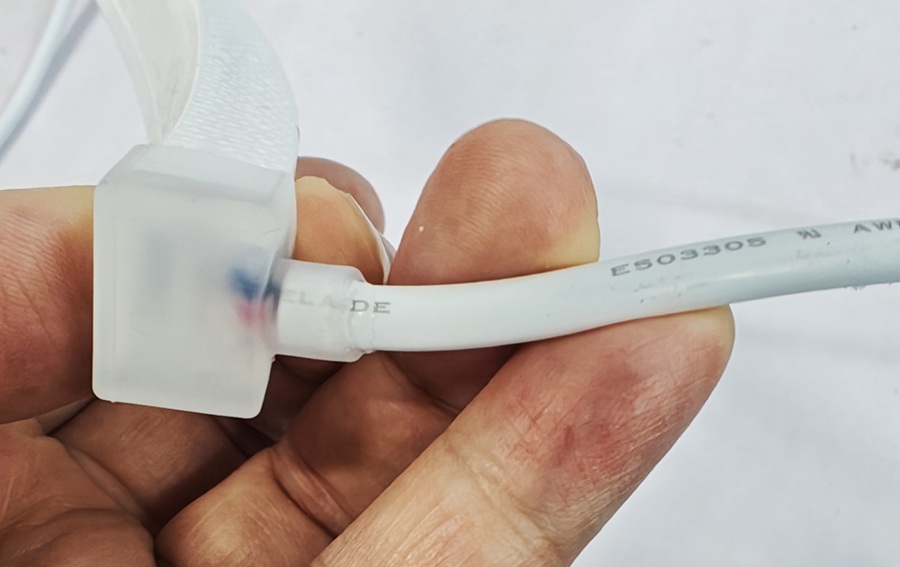
A traditional silicone neon end cap is an external accessory installed after cutting the LED neon flex.
The installation process usually includes:
- Cutting the neon flex at the required position
- Connecting wires or terminals
- Applying silicone glue inside the end cap
- Covering the end of the neon housing
- Waiting for sealing and curing
Because the end cap needs to fit over the outside of the silicone housing, it naturally creates an additional layer around the original neon profile.
For example:
A LED neon flex profile:
16mm × 15mm
After installing a silicone end cap:
The end area may become slightly larger than the original 16mm × 15mm profile.
The middle section of the neon remains the original size, but the end section becomes wider due to the additional silicone cover.
Why Does the Increased End Size Matter in Real Projects?
For open installations, this size difference may not create any problems.
However, many professional lighting projects require LED neon flex to fit into precisely designed spaces.
In these applications, the end cap dimension becomes an important factor.
Installation Inside Aluminum Profiles
One of the most common applications for LED neon flex is installation inside aluminum profiles.
For example:
A designer may select:
- 16mm wide LED neon flex
- 16mm internal width aluminum channel
The neon body fits perfectly along the entire lighting line.
However, after adding a traditional silicone end cap, the sealed end section may exceed the profile width.
Potential issues:
- The neon cannot fully enter the profile
- Additional cutting is required
- The end section becomes uneven
- Installation efficiency decreases
For large commercial projects, these small adjustments can create significant labor costs.
Customized Signage and Channel Letter Applications
LED neon flex is widely used for:
- Channel letters
- Brand logos
- Custom signage
- Decorative outlines
These applications often have limited internal space.
The designer usually creates the structure based on the exact neon flex dimensions.
If the end section becomes larger after sealing, it may affect:
- Product fitting
- Visual consistency
- Final appearance
For premium signage projects, a seamless and uniform lighting line is essential.
Furniture and Interior Linear Lighting
In interior applications, LED neon flex is often installed into:
- Cabinet grooves
- Shelves
- Wardrobes
- Mirrors
- Decorative panels
These designs usually have very limited installation space.
A small dimensional increase at the end may cause:
- Difficult installation
- Uneven positioning
- Additional modification work
For customized furniture manufacturers and interior lighting suppliers, maintaining consistent dimensions is extremely important.
How Integrated LED Neon Flex Solves the Size Problem
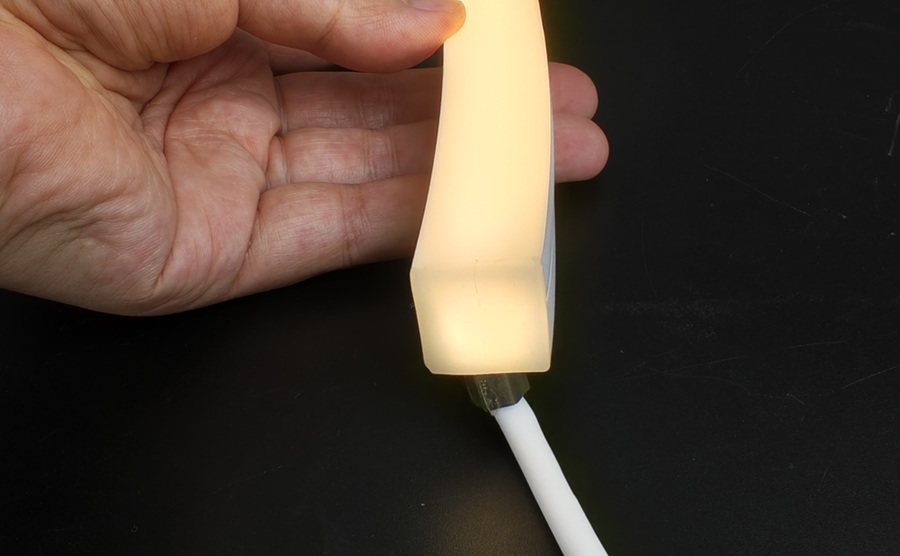
An integrated LED neon flex end cap uses a different manufacturing approach.
Instead of adding a separate silicone cap after production, the sealing structure is created together with the silicone extrusion process.
The end section becomes part of the original silicone housing.
This means:
- No external silicone sleeve
- No additional thickness
- No oversized end section
- Consistent profile dimensions
The entire neon flex maintains the same shape from beginning to end.
Advantages of Integrated End Cap Design for Precision Lighting
Consistent Dimensions Throughout the Entire Length
The biggest advantage of integrated sealing is dimensional consistency.
The LED neon flex maintains:
- Same width
- Same height
- Same appearance
from the beginning to the end.
This is especially valuable for projects with strict dimensional requirements.
Easier Installation in Narrow Spaces
For applications where space is limited, integrated end caps provide better compatibility.
Examples:
- Slim aluminum channels
- Customized metal structures
- Embedded architectural details
- Furniture lighting systems
Installers do not need to reserve additional space for a larger end section.
Better Visual Appearance
Architectural lighting is not only about illumination.
Designers also care about:
- Clean lines
- Seamless appearance
- Professional finishing
Traditional external end caps may create a visible transition point.
Integrated designs provide a smoother appearance, especially for:
- Hotel lighting
- Retail environments
- Luxury interiors
- Architectural facade lighting
Silicone Neon End Cap vs Integrated LED Neon Flex End Cap
Feature | Silicone Neon End Cap | Integrated LED Neon Flex End Cap |
Structure | External silicone accessory | One-piece silicone extrusion |
End dimension | Slightly larger than neon body | Same as original profile |
Installation | Requires additional sealing process | Ready-to-install sealing design |
Space requirement | Needs extra tolerance | Suitable for tight spaces |
Appearance | Possible visible transition | Seamless finish |
Best application | Standard projects | Precision architectural projects |
Which LED Neon Flex End Cap Solution Should You Choose?
The choice depends on the project requirements.
Silicone Neon End Cap Is Suitable For:
- Standard decorative lighting
- Indoor applications
- Cost-sensitive projects
- Installations with sufficient space
It remains a practical and economical sealing solution.
Integrated LED Neon Flex Is Recommended For:
- Architectural lighting projects
- Aluminum profile installation
- Customized signage
- Premium commercial spaces
- Projects with strict size requirements
When installation accuracy and final appearance are critical, integrated end caps provide a more professional solution.
Conclusion: End Cap Design Is More Than Just Waterproofing
Many customers think an LED neon flex end cap only affects waterproof performance.
However, the end cap design also influences:
- Final product dimensions
- Installation compatibility
- Visual quality
- Project efficiency
For standard applications, silicone end caps remain a cost-effective choice.
But for precision lighting projects where every millimeter matters, integrated LED neon flex provides better dimensional consistency and a cleaner installation result.
Other articles:
The Ultimate Guide to LED Neon Flex Strip
ESD Protection in LED Neon Strips: Why Anti-Static Manufacturing Matters
As a bespoke lighting solution provider, Yiholight specializes in high-quality LED strips and neon flex lights. Our products are engineered for durability, brightness, and ease of installation—trusted by B2B customers across the globe.
Contact us today to explore the best LED lighting for your business!
© [Yiholight] and [www.yiholight.com]. Unauthorized use or duplication of this material is strictly prohibited without express written permission from the site’s author or owner. Excerpts and links may be used, provided full, clear credit is given to [Yiholight] and [www.yiholight.com], with appropriate, specific direction to the original content.