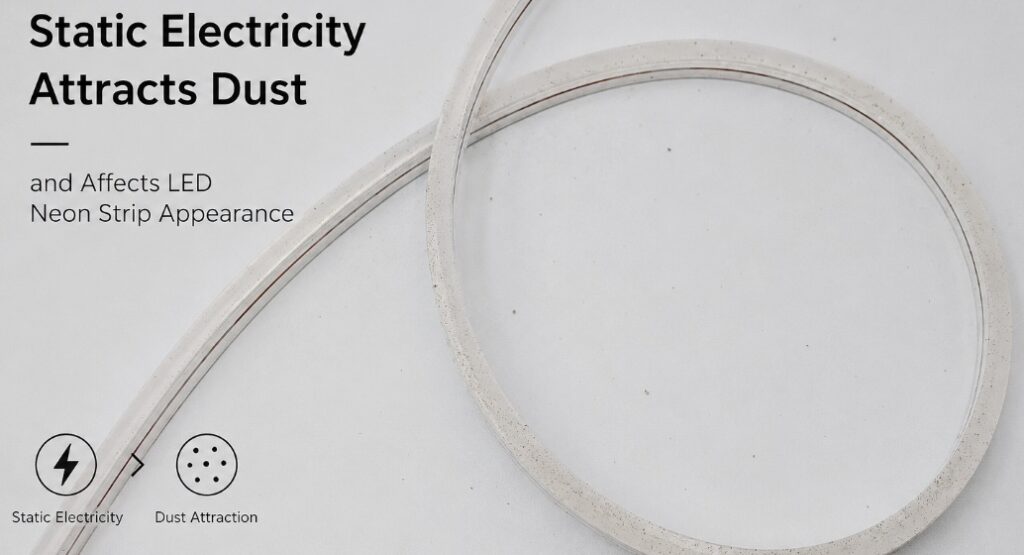
LED neon strips are widely used in architectural lighting, signage, retail displays, and commercial projects because of their smooth, dot-free illumination and premium visual effect. However, one often overlooked factor that directly affects LED neon strip appearance and quality is static electricity during manufacturing.
Static electricity can attract dust, hair, and microscopic particles to the LED neon strip during production. Once trapped inside the silicone encapsulation, these contaminants become permanent visual defects that cannot be removed.
Professional LED neon strip manufacturers use advanced anti-static manufacturing processes, such as ESD NT static protection, to prevent contamination and ensure clean, flawless products.
This article explains how static electricity affects LED neon strip appearance, why it matters, and how anti-static manufacturing ensures superior product quality.
Table of Contents
Understanding Static Electricity in LED Neon Strip Manufacturing
Static electricity is a natural phenomenon caused by electrical charge buildup on surfaces. It is generated through common activities such as:
- Movement of workers
- Friction between materials
- Contact with plastic or silicone components
- Airflow in dry environments
- Dust particle movement
These static charges can attract airborne particles, including dust, fibers, and hair.
In LED neon strip manufacturing, this creates a serious quality risk.
Why LED Neon Strips Are Highly Sensitive to Dust Contamination
LED neon strips have a sealed silicone structure designed to protect internal components and create uniform light diffusion.
Typical LED neon strip structure includes:
- LED chips mounted on PCB
- Silicone extrusion encapsulation
- Optical diffusion layer
- Fully sealed protective housing
This sealed design improves waterproofing and durability, but also means any dust trapped inside becomes permanently visible.
Unlike external surfaces, internal contamination cannot be cleaned after manufacturing.
This makes anti-static protection essential during production.
How Static Electricity Attracts Dust to LED Neon Strips
Static electricity creates an electrostatic field that pulls charged particles toward the product surface.
This process occurs in several stages:
Stage 1: Static Charge Formation
Static electricity builds up on:
- Silicone material
- PCB surfaces
- Manufacturing tools
- Worker clothing
These charged surfaces attract airborne particles.
Stage 2: Particle Attraction
Dust particles, hair, and fibers are drawn toward the charged LED neon strip.
Even microscopic particles become attached to surfaces.
These particles may settle on:
- LED chips
- PCB surface
- Internal silicone layer
Stage 3: Permanent Encapsulation
During silicone extrusion and sealing, the particles become trapped inside the neon strip.
Once sealed, these particles cannot be removed.
This creates permanent visual defects.
How Dust Contamination Affects LED Neon Strip Appearance
Dust contamination can cause several visible and functional problems.
Visible Dark Spots or Black Dots
Dust particles block light transmission.
This creates visible dark spots inside the neon strip.
These defects are especially noticeable when the strip is illuminated.
This negatively affects visual quality.
Reduced Light Uniformity
LED neon strips are designed to provide smooth, continuous light output.
Dust particles disrupt light diffusion.
This results in:
- Uneven brightness
- Light inconsistencies
- Reduced visual performance
This is unacceptable in premium lighting applications.
Reduced Product Aesthetic Quality
LED neon strips are often used in visible installations such as:
- Retail displays
- Architectural lighting
- Hotel lighting
- Signage
Visible contamination reduces product aesthetic quality and perceived value.
This may lead to customer dissatisfaction.
Brand and Project Reputation Risk
For OEM customers and distributors, product appearance directly affects brand reputation.
Contaminated LED neon strips can cause:
- Customer complaints
- Product returns
- Warranty claims
- Loss of business trust
Preventing contamination is essential for maintaining brand credibility.
How Professional Manufacturers Prevent Static Electricity Contamination
Professional LED neon strip manufacturers use advanced anti-static manufacturing processes to eliminate static charges.
These include:
Anti-static production environment
Controlled production areas minimize static buildup.
Static neutralization equipment
Ionizers neutralize static charges on materials and surfaces.
Anti-static tools and materials
Specialized tools prevent charge buildup during handling.
Controlled manufacturing procedures
Proper handling procedures reduce contamination risk.
Yiholight Uses Advanced ESD NT Static Process to Ensure Clean LED Neon Strip Production
Yiholight implements advanced ESD NT anti-static manufacturing processes to prevent dust contamination during LED neon strip production.
This process ensures:
- Static-free manufacturing environment
- Prevention of dust and hair contamination
- Clean internal silicone structure
- Consistent product appearance
- Premium product quality
This ensures every LED neon strip meets professional quality standards required by OEM customers, distributors, and lighting projects worldwide.
Why Anti-Static Manufacturing Is Critical for OEM Customers and Professional Projects
For OEM customers, distributors, and contractors, product consistency and appearance are critical.
Poor manufacturing control can result in:
- Inconsistent product quality
- Increased defect rates
- Customer complaints
- Warranty costs
Anti-static manufacturing ensures reliable, clean, and professional products.
This protects both project quality and brand reputation.
How to Identify LED Neon Strip Manufacturers Using Proper Anti-Static Protection
Buyers should evaluate manufacturers carefully.
Key indicators include:
Clean and professional manufacturing environment
Indicates proper quality control.
Consistent product appearance
High-quality neon strips should have clean internal structure.
Transparent quality control process
Professional manufacturers explain their production standards.
Experience in professional lighting manufacturing
Experienced manufacturers understand contamination risks.
Conclusion
Static electricity is a major hidden risk in LED neon strip manufacturing. It attracts dust, hair, and particles that can become permanently trapped inside the silicone structure, affecting product appearance and quality.
Professional anti-static manufacturing processes, such as ESD NT static protection, eliminate static charges and prevent contamination.
For OEM customers, distributors, and professional lighting applications, choosing manufacturers with proper anti-static protection ensures clean, reliable, and high-quality LED neon strips.
Other articles:
12v vs 24v LED strip: which voltage is right for your project?
Which LED Strip Is Better: COB or SMD?
CRI, SDCM & Color Binning Explained: Why Color Quality Matters in LED Strips
What Makes a High-Quality LED Strip? 9 Factors Buyers Must Know
Common LED Strip Lighting Problems and How to Solve Them
Understanding LED Strip Types: Chips, Colors, Voltages & Designs
As a bespoke lighting solution provider, Yiholight specializes in high-quality LED strips and neon flex lights. Our products are engineered for durability, brightness, and ease of installation—trusted by B2B customers across the globe.
Contact us today to explore the best LED lighting for your business!
© [Yiholight] and [www.yiholight.com]. Unauthorized use or duplication of this material is strictly prohibited without express written permission from the site’s author or owner. Excerpts and links may be used, provided full, clear credit is given to [Yiholight] and [www.yiholight.com], with appropriate, specific direction to the original content.