What Is Wall Washing?
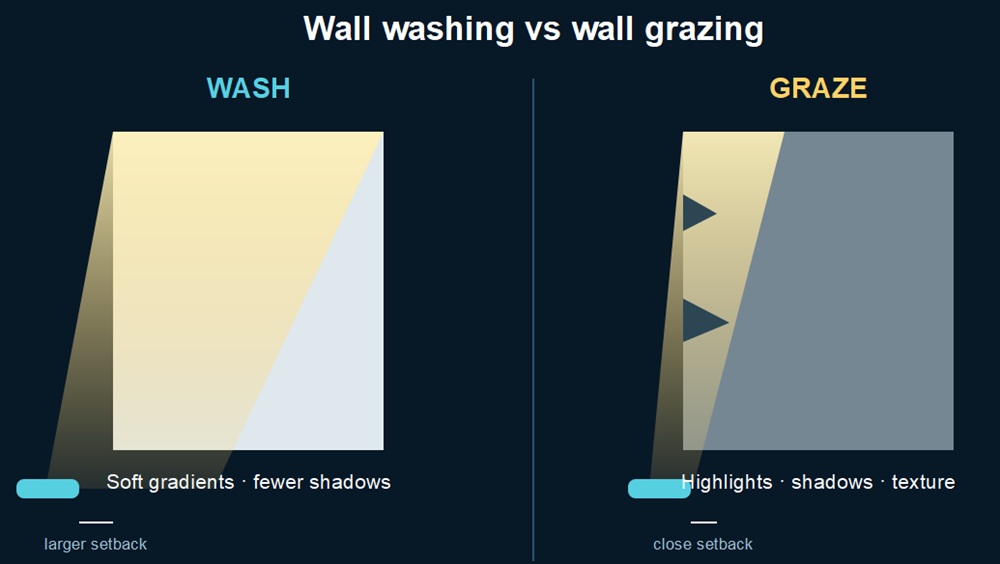
Wall washing distributes light over a large part of a vertical surface with controlled uniformity. It reduces strong shadows, softens minor surface variation and makes the wall act as a luminous background.
Common applications include:
– hotel lobbies and corridors
– galleries, graphic walls and display areas
– smooth architectural facades
– retail feature walls
– living green walls
– large murals and branded surfaces
– spaces that need greater perceived brightness
The luminaire is normally set far enough away from the wall for the beam to expand and blend. In Selux’s application guide, wall washing is described as typically using a setback of 12 inches or more, while its grazing example is within 12 inches. These values illustrate the principle but are not universal design limits; the exact product, wall height and photometry remain decisive.
What Is Wall Grazing?
Wall grazing places the source close to the surface so that light travels along the wall at a shallow angle. Small projections intercept the beam while recesses remain darker. This creates contrast that makes texture visible.
It is commonly used for:
– natural stone and stacked stone
– brickwork
– ribbed concrete
– timber slats
– relief panels and carved surfaces
– columns and organically shaped walls
– historic masonry where texture is a design feature
Grazing can be installed from above or below. Uplighting often feels more dramatic and can emphasize vertical height; downlighting can be easier to conceal in ceilings or parapets. The direction changes where shadows fall, so it should be chosen intentionally.
The Five Main Differences
Setback Distance
Moving a fixture away from the wall gives the beam room to spread. This supports coverage and blending for washing. Moving it closer makes small changes in surface height cast stronger shadows, producing a graze.
Distance alone does not guarantee the effect. A very narrow beam aimed incorrectly can still produce a bright stripe from a large setback. A broad diffuse optic mounted close to a rough wall may create a softer result than expected.
Optical Distribution
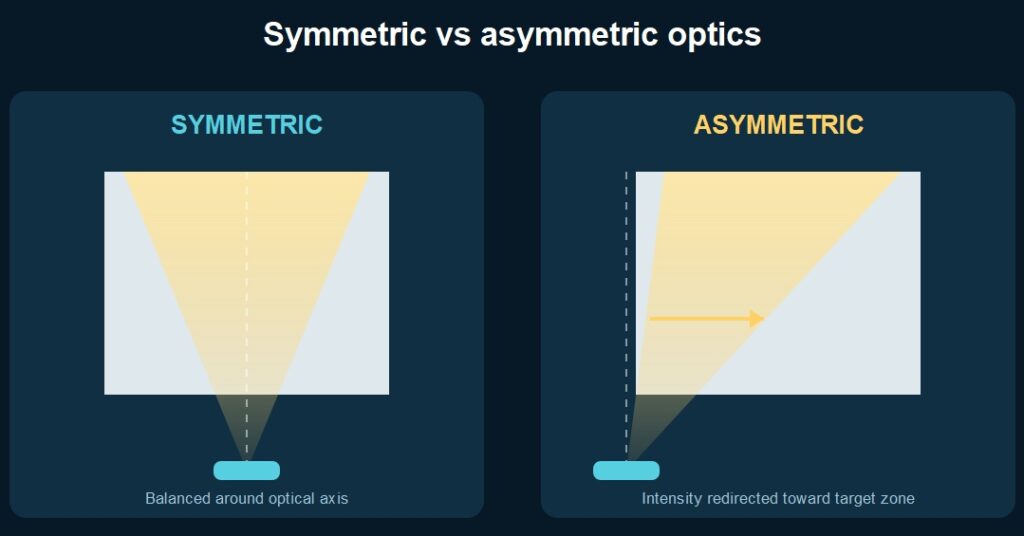
Wall washing often benefits from an asymmetric distribution that throws light toward the upper or lower zone while controlling spill near the luminaire. The objective is to balance illuminance across the wall despite different travel distances.
Grazing often uses a narrow, controlled distribution aligned along the surface. The goal is not flat uniformity; it is consistent emphasis of texture without random streaks.
Surface Appearance
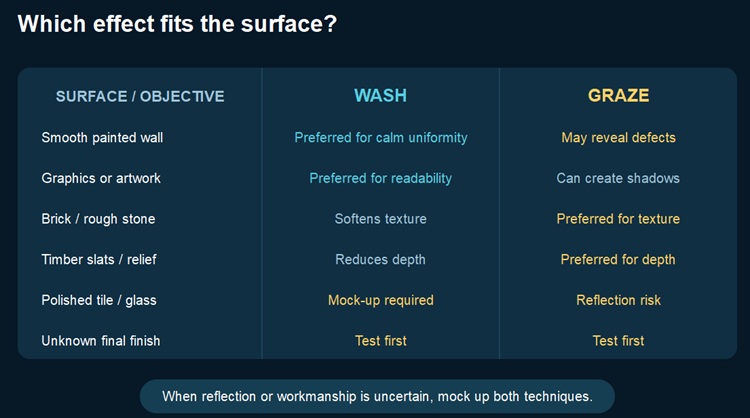
Washing tends to minimize minor bumps, joints and trowel marks. Grazing reveals them. That difference can be an advantage or a problem.
If a painted wall has uneven plasterwork, grazing may expose defects that were invisible during the day. If stone has carefully selected relief, washing may remove much of its character. Inspect the wall before choosing the technique.
Brightness Perception
A large evenly illuminated wall increases vertical luminance in the viewer’s field of vision, which can make a space feel brighter and more open. Grazing produces higher local contrast. It may feel more dramatic even if the average illumination is lower.
Installation Tolerance
Close-to-wall grazing is sensitive to small changes in setback, rotation and surface alignment. A few millimeters of movement may change a shadow line or bright streak. Washing is often more forgiving, but spacing and aiming errors can still create scallops and dark bands.
Which Technique Should You Choose?
Start with the material and design intent.
Choose wall washing when the wall should read as one continuous plane, the content on it needs balanced visibility, or the surface itself should visually recede.
Choose wall grazing when relief, craftsmanship and material depth should become the focal point.
Some projects use both. A facade may wash a smooth central volume while grazing stone piers at the entrances. A hotel lobby may wash artwork and graze a timber feature wall. Keeping the circuits separate allows commissioning teams to balance the effects.
How Beam Angle Changes the Result
For wall washing, the selected distribution must cover the required height and blend between adjacent runs. Medium, wide, elliptical or purpose-built asymmetric optics are common, depending on geometry.
For grazing, a narrower optic can maintain a directional line of light along the surface. However, “narrower” is not automatically better. On deep texture it may produce excessive contrast, while on a long wall it may reveal every installation deviation.
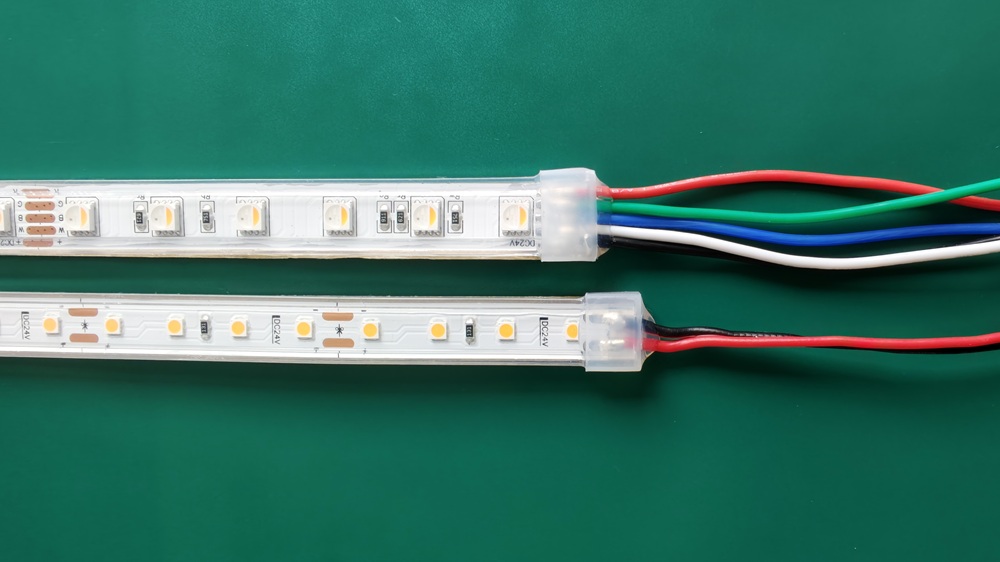
Yiholight’s flexible wall washer range includes multiple symmetric-style and elliptical optical choices for different coverage patterns. The flexible construction can follow curves and irregular outlines, but bending also changes the direction of the optic. The lens must remain consistently oriented toward the intended surface. Current options are listed on the Yiholight LED wall washer page.
Top Lighting, Bottom Lighting or Both?
Top-mounted washing can conceal the source in a ceiling slot, canopy or parapet. Designers must check whether the bottom of the wall receives enough light.
Ground-mounted uplighting can create a strong facade effect and simplify access in some landscapes. It needs glare control, drainage planning and protection from dirt or obstruction.
Two-sided lighting can reduce shadows and cover very tall features, but it can also flatten texture or double perceived brightness at the overlap. Separate dimming channels help balance the result.
For grazing, changing from uplight to downlight reverses the shadow direction. Test both orientations when the wall has strong relief.
Common Mistakes
Treating all textured walls the same
Fine plaster, split-face stone and deep timber fins respond differently. The scale and direction of the texture must be considered.
Installing before checking the finished surface
Samples viewed under diffuse daylight may look very different under a close graze. Review the actual finish and workmanship.
Using wattage as a design method
Wattage does not describe distribution. Compare photometric files and delivered illuminance.
Ignoring the viewing position
A ground-mounted grazer may be hidden from one direction and glaring from another. Walk the site along all common paths.
Expecting one spacing rule to work everywhere
Wall height, setback, optic, product length, curvature and material all affect blending. Rules of thumb are starting points only.
Mock-Up Checklist
Build a representative section before the main order when appearance is critical. Use the intended wall material, mounting channel, optic, setback and electrical load. Check:
– brightness at the near and far edges
– continuity between adjacent lengths
– shadows at joints and surface defects
– glare from normal eye level
– reflections in windows or polished materials
– appearance at full output and the intended dimmed level
– optic direction through bends
– daytime visibility of mounting hardware
Photometric simulation predicts performance, while a mock-up reveals material and human-perception issues that software may not show.
Frequently Asked Questions
Can the same fixture wash and graze a wall?
Sometimes. If the product offers appropriate optics and aiming, changing the setback can alter the effect. Dedicated distributions still produce more predictable results, so verify both options with photometry and a mock-up.
Is wall grazing suitable for smooth painted walls?
It can create intentional drama, but it will emphasize small defects, seams and waviness. Wall washing is normally safer when a visually smooth finish is desired.
Is wall washing always uniform from ceiling to floor?
No. Uniformity depends on the optical distribution, setback, aiming, wall height and spacing. A dedicated asymmetric optic can help compensate for the changing distance to the wall.
How close should a wall grazer be?
Close enough to create the required shadow contrast, but the exact distance is product- and texture-specific. Test several distances on the actual surface rather than treating 12 inches as a universal threshold.
Final Recommendation
The difference between wall washing and wall grazing is the design intention made visible. Washing softens and unifies; grazing reveals and dramatizes. Select the technique before choosing the product, then coordinate beam distribution, setback, spacing and aiming around that goal.
For curved facades or irregular architectural features, Yiholight can evaluate a suitable flexible wall washer configuration against drawings and surface information. A sample installation is the fastest way to confirm whether the final wall should look calm and continuous or richly textured.
Learn more:
Sauna & Steam Room LED Strip Lighting: Special Requirements You Must Know
LED Sauna Lights: What They Are, Why They Matter, and How to Use Them
How to Design Sauna LED Strip Lighting by Temperature Zone
Commercial Sauna Lighting for Hotels and Spas
As a bespoke lighting solution provider, Yiholight specializes in high-quality LED strips and neon flex. Our products are engineered for durability, brightness, and ease of installation—trusted by B2B customers across the globe.
Contact us today to explore the best LED lighting for your business!
© [Yiholight] and [www.yiholight.com]. Unauthorized use or duplication of this material is strictly prohibited without express written permission from the site’s author or owner. Excerpts and links may be used, provided full, clear credit is given to [Yiholight] and [www.yiholight.com], with appropriate, specific direction to the original content.