Architectural lighting is becoming more complex.
Modern buildings increasingly use curved facades, arches, rounded corners, sculptural surfaces and irregular structures that are difficult to illuminate with conventional rigid fixtures.
A traditional LED wall washer works very well on a straight wall. But once the architecture starts to curve in multiple directions, the installation becomes much more difficult.
This is where a 3D Bendable LED Wall Washer becomes useful.
Unlike conventional flexible wall washers that mainly bend in one plane, a 3D bendable wall washer is designed to follow more complex architectural geometry while still projecting controlled light onto the surface.
It combines two important capabilities:
Flexible mechanical structure + directional wall-washing optics
For architects, lighting designers and project contractors, this makes it possible to illuminate curves and irregular forms without breaking the lighting line into many short rigid fixtures.
Table of Contents
What Is a 3D Bendable LED Wall Washer?
A 3D Bendable LED Wall Washer is a flexible linear fixture designed to bend through more than one direction while maintaining a controlled light beam.
The fixture usually combines:
- Flexible PCB
- Silicone or flexible encapsulation
- Integrated optical lenses
- LED light source
- Waterproof structure
- Flexible mounting accessories
The key difference is that the product is not simply a flexible LED strip.
It is still a wall washer.
That means the light is intentionally projected outward toward a wall, facade or architectural surface.
This controlled optical behavior is what makes the product suitable for architectural wall washing.
What Does “3D Bendable” Actually Mean?
Not all flexible wall washers bend in the same way.
A standard flexible fixture may bend in only one primary direction.
For example:
- Horizontal bend
- Vertical bend
A 3D bendable wall washer is designed to handle more complex three-dimensional paths.
This can be useful when the installation surface changes direction continuously.
Examples include:
- Curved facades
- Rounded building edges
- Circular columns
- Arches
- Spiral structures
- Sculptures
- Irregular landscape features
The lighting can follow the architecture more naturally instead of being forced into short straight sections.
3D Bendable Wall Washer vs Standard Flexible Wall Washer
A standard flexible wall washer is already more adaptable than a rigid fixture.
But there is still a difference between normal flexibility and 3D flexibility.
Standard Flexible Wall Washer
Best suited for:
- Simple curves
- One-direction bending
- Long curved facades
- Circular walls
- Landscape edges
3D Bendable Wall Washer
Better suited for:
- Complex curves
- Changes in multiple directions
- Sculptural architecture
- Irregular contours
- Three-dimensional structures
The 3D version provides more freedom when the installation path does not remain in one plane.
Why Not Just Use Multiple Rigid Wall Washers?
This is possible, but it creates several practical problems.
Imagine a curved facade.
To follow the curve using rigid fixtures, the installer may need many short wall washers.
Each fixture must be:
- Mounted separately
- Aimed separately
- Wired separately
- Waterproofed separately
The result may also show:
- Visible gaps
- Beam overlap
- Uneven angles
- Dark zones between fixtures
A 3D flexible wall washer can reduce the number of joints and create a more continuous visual effect.
That can simplify both installation and nighttime appearance.
The Main Advantage: Continuous Wall Washing on Curved Surfaces
The biggest benefit is continuity.
Traditional rigid wall washers are naturally segmented.
A 3D bendable system can follow a curve as one continuous lighting line.
This helps create:
- More consistent beam direction
- Fewer dark gaps
- Smoother visual transitions
- Cleaner daytime appearance
- More integrated architectural lighting
For premium architectural projects, this difference can be significant.
How the Optical System Works
A flexible wall washer is not only about bending.
The lens determines how the light is distributed.
Different projects may require:
- Narrow beam
- Medium beam
- Wide beam
- Asymmetric beam
Typical beam angles may include:
- 15°
- 20°
- 25°
- 30°
- 35°
- 45°
- 60°
Some models also use asymmetric optics such as:
- 20×55°
- 30×50°
- Other custom distributions
The mechanical flexibility allows the fixture to follow the surface.
The optical system determines how effectively the light reaches the wall.
These two elements must be selected together.
Narrow Beam for Taller Surfaces
A narrow beam such as 15° or 20° concentrates more light in one direction.
This can be useful when:
- The wall is tall
- The fixture is installed farther away
- Stronger vertical projection is required
- Architectural columns need emphasis
A narrow beam can create a dramatic effect with stronger contrast.
Wider Beam for Softer Wall Washing
A wider beam such as 35°, 45° or 60° can create broader coverage.
This is useful when:
- The fixture is installed close to the wall
- The wall is relatively low
- The goal is smooth and even illumination
- A softer architectural effect is preferred
For curved surfaces, wider beams may also help create smoother overlap between adjacent sections.
Asymmetric Optics for Better Wall Coverage
Asymmetric wall washer optics direct more light toward the target surface.
This can improve efficiency because less light is wasted away from the wall.
Asymmetric beams can help:
- Increase vertical reach
- Improve uniformity
- Reduce wasted light
- Optimize installation distance
For architectural projects, asymmetric optics can be especially useful when the fixture location is fixed and the beam needs to be directed more precisely.
Where Is a 3D Bendable Wall Washer Used?
Curved Building facades
This is one of the most obvious applications.
Modern commercial buildings often use rounded or flowing exterior geometry.
A 3D flexible wall washer can follow the facade and create a continuous lighting line.
It works well for:
- Hotels
- Shopping centers
- Office buildings
- Resorts
- Cultural buildings
Arches and Entrances
Architectural entrances often contain arches or curved structures.
Rigid fixtures may require many small sections.
A 3D bendable wall washer can follow the shape more naturally.
This is useful for:
- Hotel entrances
- Commercial entrances
- Public buildings
- Landscape gates
Columns
Circular or irregular columns can be difficult to illuminate evenly.
A flexible wall washer can follow the circular geometry and create a more continuous wash.
This can work well in:
- Hotels
- Restaurants
- Shopping malls
- Public spaces
Sculptural Architecture
Some buildings use decorative or sculptural architectural elements rather than simple flat surfaces.
A 3D bendable wall washer can adapt to these forms.
Potential applications include:
- Public art
- Sculptures
- Architectural installations
- Feature structures
Landscape Structures
Outdoor landscapes often include:
- Curved retaining walls
- Decorative edges
- Bridges
- Garden structures
- Public installations
A flexible wall washer can follow these forms while still providing directional illumination.
Commercial Interiors
3D flexible wall washers are not limited to outdoor facades.
They can also be used in interior environments such as:
- Hotels
- Restaurants
- Showrooms
- Retail stores
- Entertainment spaces
Curved interior walls and decorative architectural features can benefit from the same flexible optical approach.
3D Bendable Wall Washer vs LED Neon Flex
These products may both bend, but they are designed for very different purposes.
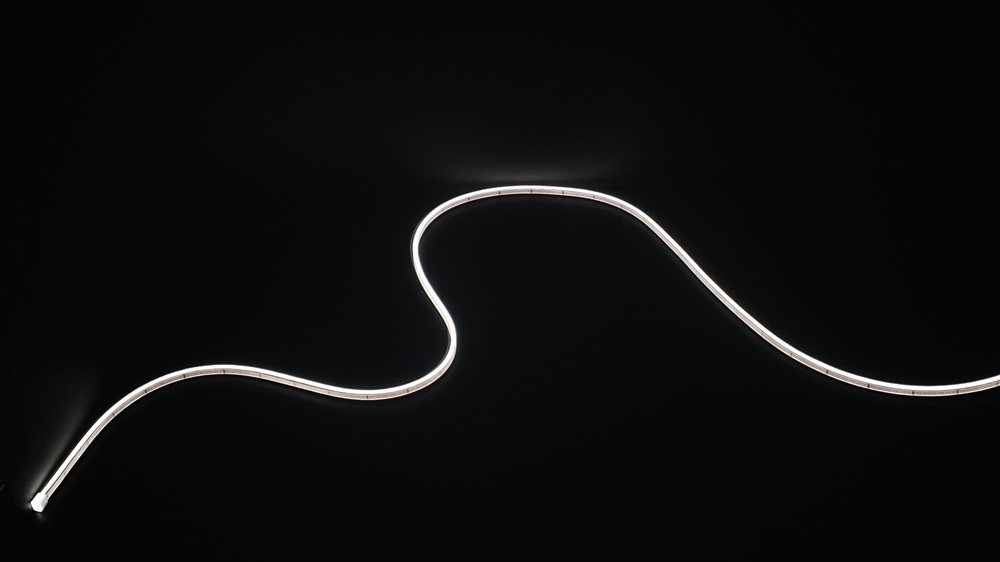
LED Neon Flex
Designed primarily for:
- Direct-view glowing lines
- Contours
- Decorative lighting
- Signage
The viewer sees the illuminated line itself.
3D Bendable Wall Washer
Designed to:
- Project light away from the fixture
- Illuminate a wall
- Create directional architectural lighting
- Highlight surface texture and geometry
A simple comparison is:
Neon Flex = visible light line
Wall Washer = illuminated surface
This distinction is important when selecting a product for architectural projects.
3D Bendable Wall Washer vs LED Strip
A conventional LED strip does not provide controlled wall-washing optics.
It produces broad light distribution.
A wall washer uses lenses to shape the beam.
That means it can project farther and create more intentional lighting patterns.
For shallow indirect lighting, an LED strip may be enough.
For facade lighting, the wall washer is usually more appropriate.
White, RGBW or DMX?
A 3D bendable wall washer can support different color and control configurations.
Single White
Best for:
- Architectural illumination
- Stone
- Concrete
- Brick
- Wood
- Neutral facadelighting
Common CCT options may include:
- 2700K
- 3000K
- 4000K
- 5000K
- 6000K
Tunable White
Useful when the project needs adjustable atmosphere.
For example:
Warm white at night.
Cooler white for events or commercial operation.
RGBW
RGBW adds a dedicated white channel to RGB.
This allows:
- Decorative color effects
- Functional white light
This is useful for hotels, commercial buildings and entertainment architecture.
DMX RGBW
DMX control allows programmable scenes across multiple zones.
It can create:
- Color chasing
- Gradients
- Sequential effects
- Dynamic facadescenes
- Event lighting
This makes 3D bendable wall washers suitable for both architectural illumination and media-style visual effects.
Outdoor Waterproofing
Many 3D bendable wall washer applications are outdoor.
Therefore waterproof design is critical.
A professional installation should consider:
- IP rating
- End caps
- Cable exits
- Connectors
- Waterproof joints
- Drainage
- Installation orientation
The fixture itself may be IP65 or IP67, but the complete system must be protected.
Water often enters through connection points rather than through the main extrusion.
Minimum Bending Radius Matters
Flexible does not mean unlimited bending.
Every flexible wall washer has a minimum bending radius.
If the product is bent too tightly, it may damage:
- PCB
- Internal wiring
- Optical lenses
- Encapsulation
- Waterproof structure
For complex architecture, always confirm:
- Required curve radius
- Bend direction
- Maximum twist
- Installation path
before selecting the final product.
For very tight geometry, a smaller profile may be more suitable than a larger high-power wall washer.
Installation Support Is Still Required
A flexible fixture should not be left unsupported.
Installation may use:
- Aluminum channels
- Mounting clips
- Flexible brackets
- Custom fixing systems
The mounting system should:
- Maintain the correct curve
- Prevent twisting
- Keep the optical direction stable
- Protect the fixture from excessive mechanical stress
For architectural projects, the mounting design can be just as important as the wall washer itself.
Power and Heat Management
Flexible wall washers may operate at relatively high power per meter.
This means heat management must be considered.
Factors include:
- PCB design
- Power density
- Fixture material
- Installation surface
- Ambient temperature
- Operating time
Higher wattage is not automatically better.
The correct wall washer should provide enough light while maintaining reliable thermal performance.
How to Select a 3D Bendable Wall Washer
Before selecting a product, confirm the following:
1. Architectural Geometry
Is the surface:
- Straight
- Curved
- Circular
- Irregular
- Three-dimensional
This determines whether standard flexible or 3D bendable construction is required.
2. Minimum Bending Radius
Measure the tightest curve.
3. Wall Height
Taller walls may require narrower optics.
4. Installation Distance
The distance between the fixture and wall influences beam selection.
5. Required Lighting Effect
Do you need:
- Smooth wall washing
- Strong grazing
- Narrow projection
- Wide coverage
6. Color
Choose:
- Single white
- Tunable white
- RGB
- RGBW
7. Control
Choose between:
- Simple on/off
- Dimming
- DMX
- Dynamic RGBW control
8. Environment
Indoor or outdoor?
Wet or dry?
This determines waterproofing requirements.
Common Mistakes
Choosing the Product Only by Wattage
Higher power does not guarantee better wall washing.
Optics matter just as much.
Ignoring the Bending Radius
A product may be flexible but still unsuitable for the required curve.
Using the Wrong Bend Direction
Confirm whether the wall washer can bend in the direction required by the architecture.
Ignoring Mounting Support
Without proper fixing, the fixture may twist and change beam direction.
Treating Flexible Wall Washer Like LED Neon
The optical purpose is different.
Wall washer lighting should be designed according to surface illumination, not just visible line brightness.
Why 3D Flexibility Matters in Modern Architecture
Architecture is moving away from simple rectangular forms.
Curves, organic geometry and sculptural structures are increasingly common.
Lighting needs to follow the same design language.
A 3D bendable wall washer allows the fixture to adapt to the architecture rather than forcing the architecture to adapt to a rigid lighting product.
This creates greater freedom for:
- Architects
- Lighting designers
- Contractors
- Landscape designers
The result is a more integrated lighting effect with fewer visible breaks.
Looking for a 3D Bendable LED Wall Washer?
YIHOLIGHT provides flexible architectural wall washer solutions including:
- 3D Bendable Silicone Wall Washer
- Flexible PU Wall Washer
- Multiple profile sizes
- Multiple beam angles
- Symmetric optics
- Asymmetric optics
- Single White
- Tunable White
- RGB / RGBW
- DMX RGBW
- Outdoor waterproof options
If your project includes a curved facade, arch, column, sculpture or irregular architectural surface, send us:
- Project drawing
- Curve radius
- Installation distance
- Wall height
- Required beam angle
- CCT / RGBW
- Control method
We can help evaluate the appropriate profile, bending structure, optical distribution and control solution before sampling.
Learn more:
Flexible vs Rigid LED Wall Washer: Which Is Better for Architectural Lighting?
Symmetric vs Asymmetric Wall Washer Optics: How to Choose the Right Light Distribution
How to Install Flexible LED Wall Washers on Curved Facades
→ Explore LED Wall Washer Series
As a bespoke lighting solution provider, Yiholight specializes in high-quality LED strips and neon flex. Our products are engineered for durability, brightness, and ease of installation—trusted by B2B customers across the globe.
Contact us today to explore the best LED lighting for your business!
© [Yiholight] and [www.yiholight.com]. Unauthorized use or duplication of this material is strictly prohibited without express written permission from the site’s author or owner. Excerpts and links may be used, provided full, clear credit is given to [Yiholight] and [www.yiholight.com], with appropriate, specific direction to the original content.