Creating smooth, uniform backlighting is not always as simple as placing LED strips behind a panel.
For a narrow shelf or straight aluminum profile, conventional LED strips work well.
But what happens when the project involves a large illuminated surface, an irregular logo, a curved display, a shallow light box or a shape that does not follow straight lines?
Using multiple LED strips can create extra wiring, uneven spacing and visible bright or dark areas.
This is where an LED Sheet becomes a different kind of lighting solution.
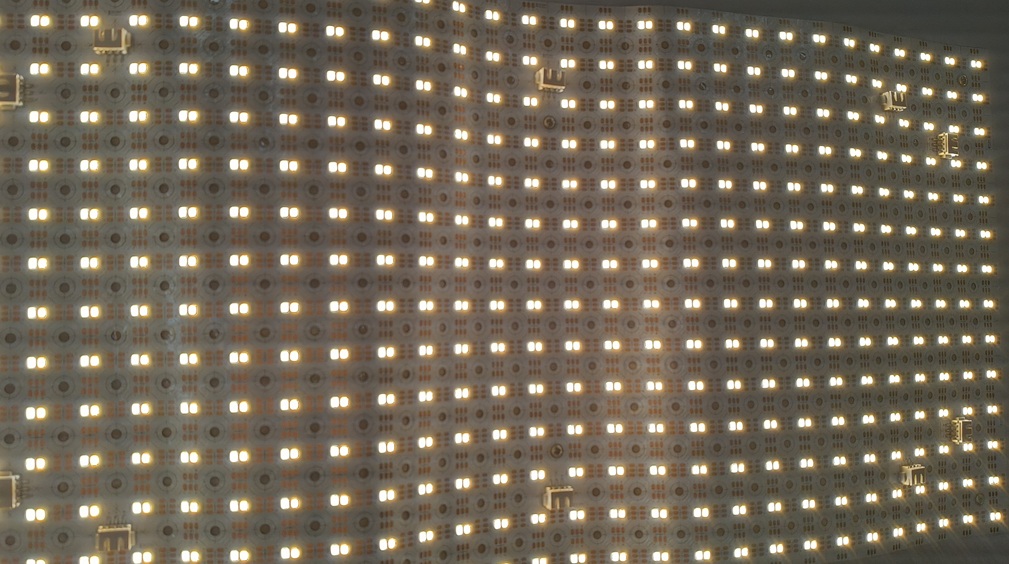
A Flexible LED Sheet, also called an LED Light Sheet or Flexible LED Panel, combines a thin modular PCB with a matrix of LEDs that can be cut in multiple directions and connected quickly.
Instead of building a backlight line by line, designers can create an entire illuminated surface.
For signs, retail displays, light boxes, architectural panels and customized lighting structures, this can significantly simplify both design and installation.
Table of Contents
What Is an LED Sheet?
An LED Sheet is a thin, flexible lighting panel made from a PCB populated with LEDs in a grid pattern.
Unlike conventional LED strips, where LEDs are arranged along one narrow line, LEDs on a sheet are distributed across a two-dimensional surface.
This makes LED sheets particularly suitable for large-area backlighting.
The sheet can typically be cut along designated cutting lines in several directions, allowing it to fit rectangles, curves, letters and other customized shapes.
The referenced flexible LED sheet system, for example, allows cutting horizontally, vertically and diagonally along its cutting grid. It also uses quick-connect cables to simplify electrical connections.
That combination of:
Large-area illumination + multidirectional cutting + modular connection
is what separates LED sheets from ordinary LED strips.
LED Sheet vs. LED Strip: What Is the Difference?
Both products use LEDs mounted on flexible PCBs, but their intended applications are different.
A traditional LED strip is essentially a one-dimensional light source.
It works extremely well for:
- Linear profiles
- Cove lighting
- Shelves
- Cabinets
- Edge lighting
- Decorative lines
An LED sheet is designed as a two-dimensional lighting platform.
Instead of creating a line of light, it creates an illuminated surface.
This makes it useful when a project requires light across a wider area.
For example, imagine a rectangular illuminated advertising panel.
Using normal LED strips may require several parallel rows.
The installer then needs to:
- Calculate the spacing between strips
- Cut multiple lengths
- Run multiple wires
- Keep brightness consistent
- Avoid visible bright lines
- Prevent dark zones between rows
With a flexible LED sheet, many of these LEDs are already arranged in a predetermined grid.
The installer can trim the sheet to the required shape and connect sections together.
This can make the backlighting structure considerably simpler.
Why Is LED Sheet Useful for Backlighting?
Backlighting requires more than brightness.
The real challenge is uniformity.
If individual LEDs are too far apart or the distance between the LEDs and diffuser is too shallow, bright spots may become visible.
If LED strips are installed unevenly, dark bands can appear.
A well-designed LED Sheet for Backlighting distributes LEDs over the surface more consistently.
This can help reduce:
- Bright lines
- Dark zones
- Uneven spacing
- Complex strip layouts
- Excessive wiring
For this reason, LED sheets can be particularly useful in shallow installations where traditional strip spacing becomes difficult.
The result is not simply easier installation.
It can also give designers more freedom to reduce the depth of certain illuminated structures.
Cut Horizontally, Vertically and Diagonally
One of the strongest advantages of a flexible LED sheet is its cutting flexibility.
Conventional LED strips are cut across one direction.
A sheet can be much more versatile.
The reference single-color and RGBW LED sheets can be cut along designed cutting lines:
- Horizontally
- Vertically
- Diagonally
This enables the panel to adapt to irregular two-dimensional forms.
For sign manufacturers, this can be particularly valuable.
Instead of filling an irregular letter or logo with many short pieces of LED strip, a sheet can be shaped around parts of the design.
Possible shapes can include:
- Letters
- Logos
- Curved graphics
- Circular forms
- Triangles
- Irregular display panels
- Customized light boxes
The key advantage is simple:
The light source can be adapted to the shape rather than forcing the shape to adapt to standard LED strips.
Easy Connection Can Reduce Installation Work
Cutting flexibility is useful only if the resulting sections can also be connected efficiently.
This is why connector design matters.
Flexible LED sheets can use quick-connect terminals or cables to connect sheet sections and power inputs without requiring extensive point-to-point wiring.
The referenced LED sheet system specifically highlights quick connector cables for joining panels, while the RGB/RGBW versions can be combined with controllers, remotes and additional accessories.
For professional applications, this can help reduce:
- Soldering work
- Wiring complexity
- Installation time
- Assembly mistakes
For OEM manufacturers producing the same illuminated panel repeatedly, this can also make the production process more standardized.
Different Types of LED Sheet
Not every project needs the same lighting effect.
LED sheets can be divided into several major categories depending on the application.
Single-Color LED Sheet
A Single Color LED Sheet is generally the simplest solution for uniform white backlighting.
Typical color temperatures may range from warm white to cool white.
The referenced version is available from approximately 2700K to 6000K, uses DC24V and offers CRI ≥90 with color consistency below 3 SDCM.
Single-color sheets are particularly suitable for:
- Light boxes
- Fabric graphics
- Advertising panels
- Logo backlighting
- Retail displays
- Ceiling features
- Architectural surfaces
If the objective is simply clean, even white illumination, this is often the most practical solution.
RGB and RGBW LED Sheet
For applications that require color-changing effects, an RGB LED Sheet or RGBW LED Sheet provides more flexibility.
RGB combines red, green and blue channels to create different colors.
RGBW adds a dedicated white channel.
This is particularly useful because a dedicated white LED can usually produce a more practical white-light appearance than generating white using RGB channels alone.
The referenced RGBW flexible LED sheet uses a modular, cuttable design and supports smart control through a complete accessory system including dimming controllers, remotes and connectors.
An RGBW LED Sheet can work well in:
- Brand displays
- Retail environments
- Bars and hospitality
- Exhibition booths
- Decorative panels
- Customized illuminated furniture
During normal operation, the panel can provide white light.
When required, it can switch to colorful decorative effects.
Pixel LED Sheet
A Pixel LED Sheet goes significantly further.
Instead of controlling the entire panel as one RGB or RGBW zone, the sheet is divided into individually addressable pixels or controllable areas.
This means different areas can display different colors at the same time.
With SPI control, designers can create:
- Color chasing
- Gradients
- Flowing effects
- Animated graphics
- Sequential lighting
- Dynamic patterns
The referenced SPI Pixel RGBW LED Sheet uses DC24V, a 480 × 240mm sheet format and an addressable RGBW configuration, with a 48 × 48mm cutting unit and SPI signal control.
This transforms the LED sheet from a simple backlight into a programmable visual surface.
RGBW LED Sheet vs. Pixel RGBW LED Sheet
The difference is important.
A standard RGBW LED Sheet usually changes the entire connected zone together.
For example:
Blue → Red → Green → White.
The whole section responds as one lighting area.
A Pixel RGBW LED Sheet allows multiple colors and effects to exist across the sheet simultaneously.
For example:
One area can be red.
Another can be blue.
Another can be white.
And the colors can move across the panel.
Therefore:
Choose RGBW LED Sheet when you need:
- Static color changing
- Scene control
- Decorative RGB colors
- Dedicated white lighting
- Simpler control
Choose Pixel LED Sheet when you need:
- Chasing effects
- Animated lighting
- Multiple colors simultaneously
- Programmable sequences
- Dynamic brand experiences
This distinction is particularly important when specifying products for commercial displays.
Where Are Flexible LED Sheets Used?
Signage and Illuminated Logos
Sign manufacturers are one of the most natural users of LED sheet technology.
Traditional sign backlighting often uses LED modules or multiple strips.
For irregular logos or customized graphics, this can require a large amount of manual layout work.
A Flexible LED Sheet for Signs can be trimmed around different shapes while keeping the LED distribution relatively consistent.
This can make it useful for:
- Logo backlighting
- Fabricated letters
- Brand walls
- Advertising panels
- Graphic features
- Indoor signage
RGBW or pixel versions can further turn a static sign into a dynamic lighting feature.
Light Boxes
One of the biggest challenges in light-box design is depth.
If LEDs are too close to the diffuser, visible spots can appear.
If the cabinet is made deeper, the final product becomes bulkier.
Because an LED sheet distributes many LEDs over a large surface, it can help designers create more compact LED backlighting systems.
This makes it useful for:
- Retail light boxes
- Advertising displays
- Menu boards
- Exhibition graphics
- Decorative wall panels
The exact required depth still depends on LED density, diffuser material, optical design and brightness requirements, but LED sheets provide another way to optimize the structure.
Retail Display Lighting
Retail fixtures increasingly combine furniture, branding and lighting into one structure.
An LED sheet can be installed behind:
- Translucent acrylic
- Fabric graphics
- Stone
- Decorative resin
- Diffusers
- Product-display surfaces
This helps create a larger glowing area rather than a visible line of light.
For cosmetics, fashion, electronics and luxury retail, the result can create a more integrated visual effect.
Exhibition and Event Displays
Exhibition structures are often highly customized.
They may include logos, graphics, curves and temporary illuminated panels.
A cuttable LED sheet allows designers to create lighting around these unique shapes without building every area from separate strips.
RGBW and pixel versions can also add dynamic effects for:
- Exhibition booths
- Product launches
- Brand activations
- Stage elements
- Event decorations
Furniture and Interior Lighting
LED sheets can also be integrated into furniture.
Examples include:
- Illuminated tables
- Display cabinets
- Backlit shelves
- Decorative wall panels
- Reception desks
- Bar counters
Because the lighting surface can be relatively thin, designers can integrate illumination into structures where conventional luminaires would require more space.
Backlit Stone and Decorative Materials
Translucent stone and decorative panels are increasingly used in high-end interiors.
The challenge is creating a smooth light source behind the material without visible LED lines.
A flexible sheet can spread the light over a larger area and may help simplify the backlighting arrangement.
Potential applications include:
- Onyx
- Artificial translucent stone
- Decorative resin
- Acrylic
- Glass features
- Backlit wall panels
The final optical effect should always be tested with the actual material because every diffuser or decorative surface has different transmission characteristics.
LED Sheet vs. LED Modules
LED modules are also widely used for signage and light boxes.
So when should an LED sheet be considered?
LED modules are excellent when:
- The box is relatively deep
- Cost needs to be minimized
- Irregular spacing is acceptable
- Installation volume is large
- Standard signage construction is used
- LED sheets become more attractive when:
- Installation depth is limited
- Uniform LED distribution matters
- Shapes are complex
- Fast modular installation is valuable
- A premium lighting effect is required
- RGBW or pixel control is needed
Neither technology is automatically better.
The right solution depends on the project structure.
What Should You Check Before Choosing an LED Sheet?
Professional buyers should evaluate several factors.
Sheet Size
A common modular format may be around 480 × 240mm, but the final installation can normally combine or cut multiple sheets. The referenced single-color, RGBW and SPI pixel models all use this basic panel format.
Cutting Unit
This determines how precisely the LED sheet can follow the final shape.
Smaller cutting units provide more freedom.
For example, the referenced white LED sheet uses a cutting unit of approximately 17.1 × 17.1mm, while the RGBW sheet uses approximately 24 × 24mm.
Voltage
DC24V is commonly used in professional LED-sheet systems and is used across the referenced ranges.
LED Density
Higher LED density can help achieve greater uniformity at shallower diffusion distances.
However, density should always be considered together with power, heat and optical requirements.
Color Quality
For white-light applications, look at:
- CRI
- CCT
- SDCM
- Luminous efficacy
For premium retail or material displays, high CRI and consistent color can be particularly important.
Control Requirement
Determine whether the project needs:
- Single color
- Dimming
- RGB
- RGBW
- SPI pixel control
Choosing the correct control architecture before installation avoids unnecessary redesign later.
Power Supply and Wiring
Large illuminated surfaces can consume significant power.
Power injection, wiring gauge, controller capacity and power-supply loading should therefore be calculated before installation.
This becomes especially important with high-power RGBW and pixel LED sheets.
Why Modular Design Matters for OEM Projects
For OEM manufacturers, the most important advantage of an LED sheet may not simply be brightness.
It is design flexibility.
A single sheet platform can potentially be adapted to many different product sizes.
Instead of developing a completely new rigid PCB for every illuminated shape, manufacturers can cut and combine standard LED sheets.
This can reduce development complexity for:
- Sign manufacturers
- Retail fixture manufacturers
- Furniture brands
- Lighting companies
- Display manufacturers
- Interior-product manufacturers
- Depending on the project, customization may include:
- LED density
- CCT
- CRI
- RGB or RGBW configuration
- Pixel control
- Cable lengths
- Connectors
- Adhesive backing
- Sheet dimensions
- OEM labeling
- Packaging
For repeated production, pre-cut or pre-wired configurations can also simplify assembly at the customer’s factory.
From Backlighting to a Programmable Lighting Surface
The evolution of LED sheet technology is particularly interesting.
A basic white LED sheet solves one problem:
How do we illuminate a large surface evenly?
An RGBW sheet adds another possibility:
How can the same surface change color?
A pixel LED sheet takes the idea further:
How can the entire surface become programmable?
This means LED sheets are no longer limited to hidden backlighting.
They can increasingly become part of the visual design itself.
A logo can change color.
A retail wall can display moving gradients.
A decorative panel can produce animated lighting.
An exhibition structure can become part of an interactive visual experience.
For designers, this creates a bridge between traditional backlighting and digital lighting effects.
Is LED Sheet the Right Solution for Your Project?
LED sheets are particularly worth considering when the project involves several of these requirements:
- Large-area illumination
- Shallow installation depth
- Customized shapes
- Uniform backlighting
- Quick modular connection
- RGB or RGBW color changing
- Dynamic pixel effects
For a simple straight line, LED strip may still be the better solution.
For deep channel letters, conventional LED modules may still be more economical.
But when the application requires a thin, flexible and customizable illuminated surface, LED sheet offers an alternative that neither traditional strips nor modules provide in quite the same way.
Looking for a Flexible LED Sheet Solution?
If you are developing a light box, illuminated logo, retail display, exhibition structure, backlit panel or custom lighting product, YIHOLIGHT can help evaluate the appropriate LED sheet solution.
Available solution directions can include:
- Single-color LED Sheet
- RGB LED Sheet
- RGBW LED Sheet
- SPI Pixel RGBW LED Sheet
- Customized cutting layouts
- Connectors and wiring
- Controllers
- Power supplies
- OEM and private-label configurations
Send us your drawing, dimensions, required lighting depth or desired visual effect.
We can help evaluate the LED density, cutting layout, color configuration, controller and wiring solution before sampling.
YIHOLIGHT — Flexible Linear and Surface Lighting Solutions for Creative Applications
Learn more:
What Is A LED Sheet Strip, and How Does It Differ from a Traditional LED Strip
Is LED Sheet Suitable for Backlighting and Signage
Applications of Ultra-Slim LED Sheets
LED Strip Lighting for Signage & Lighting Box
As a bespoke lighting solution provider, Yiholight specializes in high-quality LED strips and neon flex. Our products are engineered for durability, brightness, and ease of installation—trusted by B2B customers across the globe.
Contact us today to explore the best LED lighting for your business!
© [Yiholight] and [www.yiholight.com]. Unauthorized use or duplication of this material is strictly prohibited without express written permission from the site’s author or owner. Excerpts and links may be used, provided full, clear credit is given to [Yiholight] and [www.yiholight.com], with appropriate, specific direction to the original content.