Voltage drop is one of the most common — and most misunderstood — issues in LED strip lighting projects. It rarely appears in product brochures, yet it is responsible for countless real-world problems such as uneven brightness, color inconsistency, and customer complaints.
Whether in architectural lighting, retail displays, or long-run installations, voltage drop directly affects performance, appearance, and reliability.
This article explains what voltage drop is, why it happens in LED strip lighting, how to calculate it, and — most importantly — how professionals design systems to avoid it.
Table of Contents
What Is Voltage Drop in LED Strip Lighting?
Voltage drop occurs when electrical voltage decreases along the length of a conductor due to resistance.
In LED strip lighting, this means:
- Higher voltage at the power input
- Lower voltage at the far end of the strip
Because LEDs are voltage-sensitive devices, even a small voltage drop can lead to:
- Reduced brightness
- Color temperature shift
- Uneven light output
The longer the strip and the higher the current, the more noticeable voltage drop becomes.
Why Voltage Drop Is Especially Common in LED Strips
LED strips are particularly vulnerable to voltage drop due to their structure.
Key Structural Factors
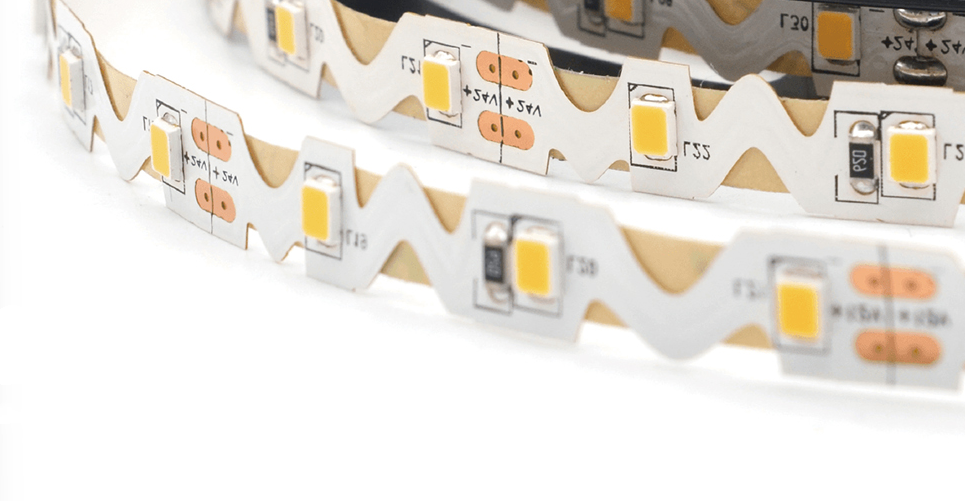
- Thin copper traces on flexible PCB
- Long continuous runs
- High LED density
- Constant voltage power supply design
Unlike rigid luminaires, LED strips rely on long PCB conductors, which naturally introduce resistance.
💡 Voltage drop is not a defect — it is a physical reality that must be managed through design.
Typical Symptoms of Voltage Drop
Voltage drop problems are often mistaken for product defects.
Common Visual Symptoms
- Bright at the beginning, dim at the end
- Gradual brightness decrease along the strip
- Color shift toward warmer tones
- Uneven illumination in long runs
In RGB or tunable white strips, voltage drop can also cause:
- Color imbalance
- Inaccurate color mixing
- Inconsistent CCT control
The Relationship Between Voltage, Current, and Strip Length
To understand voltage drop, three variables matter most:
1. Current
Higher current causes greater voltage drop. High-power LED strips draw more current and therefore experience stronger voltage loss.
2. Length
The longer the LED strip, the more resistance the current encounters.
3. PCB Copper Thickness
Thicker copper reduces resistance, helping voltage remain stable over longer distances.
This explains why high-quality LED strips with thicker copper PCBs maintain brightness better in long installations.
Constant Voltage vs Constant Current and Voltage Drop
System architecture plays a critical role.
Constant Voltage LED Strips (12V / 24V)
- Most common design
- Voltage drop increases with length
- Require careful power injection planning
Constant Current LED Strips
- Regulate current internally
- Maintain consistent brightness
- Significantly reduce voltage drop effects
For professional projects with long runs or high uniformity requirements, constant current designs offer clear advantages.
Why 24V LED Strips Perform Better Than 12V
Voltage level directly impacts voltage drop behavior.
12V LED Strips
- Higher current for same power
- More severe voltage drop
- Shorter maximum run length
24V LED Strips
- Lower current
- Reduced voltage drop
- Longer continuous runs
- Better brightness uniformity
This is why most professional LED strip systems prefer 24V designs, especially for architectural and commercial projects.
Power Injection: The Most Effective Solution
Power injection is the most widely used and effective method to manage voltage drop.
What Is Power Injection?
Supplying power to the LED strip from multiple points instead of only one end.
Common Power Injection Methods
- Single-end feed (short runs only)
- Double-end feed
- Middle feed
- Multiple parallel feeds for long installations
- Proper power injection:
- Balances voltage across the strip
- Eliminates brightness gradients
- Improves color consistency
Professional installers plan power injection before installation, not as a correction afterward.
PCB Design and Voltage Stability
PCB quality directly affects voltage drop behavior.
High-Quality PCB Design Includes:
- Thicker copper layers
- Wider power traces
- Optimized current paths
- Stable solder joints
Low-cost PCBs with thin copper increase resistance, making voltage drop more severe — even on short runs.
This is why PCB design is a hidden but critical factor in voltage performance.
Calculating Voltage Drop in LED Strip Projects
While exact calculations require detailed parameters, professionals use practical guidelines.
General Industry Guidelines
- Avoid exceeding recommended max run length
- Choose 24V over 12V whenever possible
- Increase power injection for high-power strips
- Use aluminum profiles to stabilize performance
Manufacturers typically provide maximum run length recommendations — exceeding them almost guarantees voltage drop issues.
Why Voltage Drop Affects Color Quality
Voltage drop does not only reduce brightness — it also affects color accuracy.
Color Impact Includes:
- Warmer color shift in white LEDs
- Inconsistent CCT in tunable white strips
- Color imbalance in RGB and RGBW systems
For high-CRI and architectural lighting, voltage drop can undermine even the best LED chips if not properly controlled.
Voltage Drop and Long-Term Reliability
Voltage drop causes uneven electrical stress along the strip.
- LEDs near the power input run hotter
- LEDs at the end run cooler but dimmer
- Aging becomes uneven
- Visual inconsistency increases over time
Balanced voltage distribution improves both appearance and lifespan.
Conclusion: Voltage Drop Is a Design Challenge — Not a Product Flaw
Voltage drop is unavoidable in LED strip lighting — but its impact is fully controllable with proper design.
- Choose the right voltage level
- Use quality PCB design
- Plan power injection carefully
- Match system components correctly
Professional LED strip performance is not defined by the strip alone, but by how the entire system is engineered.
Other articles:
CRI, SDCM & Color Binning Explained: Why Color Quality Matters in LED Strips
Understanding LED Strip Types: Chips, Colors, Voltages & Designs
Flicker-Free LED Strip Lighting: Causes, Risks, and Professional Solutions
As a bespoke lighting solution provider, Yiholight specializes in high-quality LED strips and neon flex lights. Our products are engineered for durability, brightness, and ease of installation—trusted by B2B customers across the globe.
Contact us today to explore the best LED lighting for your business!
© [Yiholight] and [www.yiholight.com]. Unauthorized use or duplication of this material is strictly prohibited without express written permission from the site’s author or owner. Excerpts and links may be used, provided full, clear credit is given to [Yiholight] and [www.yiholight.com], with appropriate, specific direction to the original content.