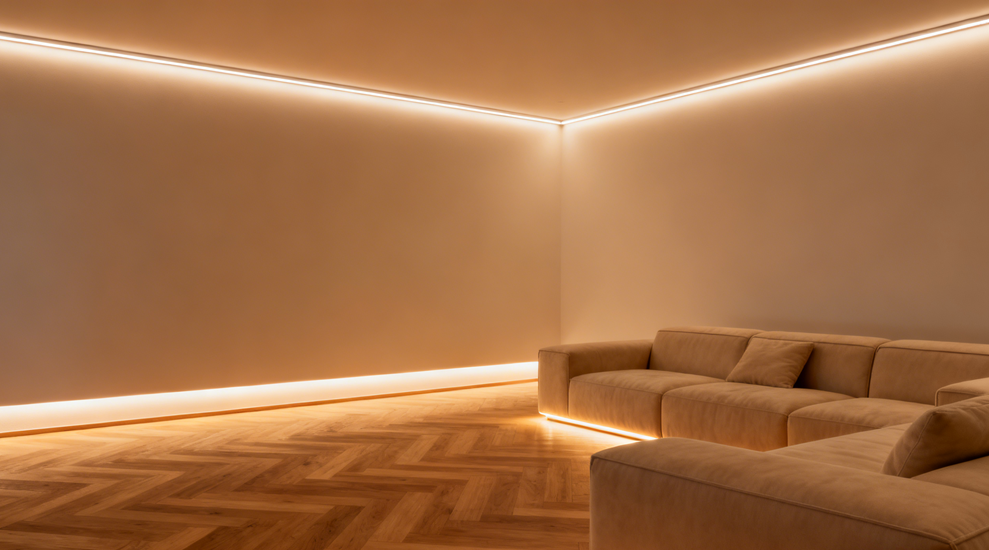
When you walk into a space, the lighting can completely transform how everything looks — from skin tones and clothing to furniture and artwork. But have you ever wondered why some lights make colors appear more vivid and natural than others?
The secret lies in a measurement known as CRI, or Color Rendering Index.
If you’re in lighting design, architecture, or procurement, understanding CRI isn’t optional — it’s essential. In this post, we’ll answer the five most important questions about CRI and explain why it matters in modern LED lighting design.
Table of Contents
What Is CRI (Color Rendering Index)?
CRI measures how accurately a light source reveals colors compared to a natural reference, like sunlight or an incandescent bulb.
The scale ranges from 0 to 100 — with 100 CRI representing perfect color rendering.
Here’s a simple breakdown:
- CRI 90–100: Excellent. Ideal for places where color accuracy is critical (art galleries, studios, showrooms, retail).
- CRI 80–89: Good. Common in offices, homes, and general commercial lighting.
- CRI below 80: Poor. Colors may look dull or distorted.
Think of CRI as a “color fidelity score.” The higher the score, the more realistic and true-to-life colors appear under that light.
Why Is CRI Important in LED Lighting?
LED technology has advanced rapidly, but not all LEDs deliver the same color performance.
High CRI lighting helps achieve visual comfort, better aesthetics, and functional accuracy — all critical in professional environments.
Let’s look at where CRI makes a real impact:
• Retail & Showrooms
Products look their best under high CRI lighting — true colors influence perception and purchasing behavior. A garment or cosmetic that looks dull under poor lighting can lose sales appeal instantly.
• Hospitality & Restaurants
Warm, high-CRI LED lighting creates ambiance while keeping food and décor colors natural and appetizing.
• Art Galleries & Museums
Artworks require near-perfect color fidelity (CRI 95+) to represent the artist’s original tones without distortion.
• Healthcare & Laboratories
Accurate lighting helps medical professionals see true colors — critical for diagnosis and precision tasks.
• Residential Interiors
Homeowners prefer warm, high-CRI LEDs in living spaces and kitchens for comfort and realistic color tones.
Simply put: better CRI = better experience.
How Is CRI Measured?
CRI is measured by comparing how a light source renders eight standard test colors (R1–R8) compared to a reference source.
However, the most accurate method uses 15 test colors (R1–R15), with R9 (saturated red) being particularly important for skin tones, clothing, and food.
Quick Guide to CRI Measurement:
- Ra: The average of R1–R8 — this is what’s typically displayed as the CRI rating.
- R9–R15: Extended color samples for more demanding applications.
For example, two LED strips may both have CRI 90, but one with high R9 will display skin tones and warm colors far better.
That’s why Yiholight prioritizes CRI 90+ LEDs with excellent R9 values, ensuring high performance across every application.
CRI vs CCT: What’s the Difference?
CRI and CCT (Correlated Color Temperature) are two of the most commonly confused terms in lighting.
Here’s the difference:
- CRI measures color accuracy.
- CCT measures the color tone of light — whether it’s warm (2700K), neutral (4000K), or cool (6000K).
Example:
- A 2700K CRI 95 light will render colors naturally in warm tones.
- A 6000K CRI 95 light will do the same, but in a cooler white tone.
So, while CCT defines mood and atmosphere, CRI defines quality and accuracy.
Both are critical for selecting the right LED lighting for each application — especially in retail, hospitality, and architectural projects.
How to Choose High-CRI Lighting for Your Project
Choosing the right CRI depends on your application and visual priorities.
Here’s a quick guide for different environments:
Application | Recommended CRI | Notes |
Residential spaces | 90+ | Warmer CCT (2700–3000K) preferred |
Retail & fashion | 90–95+ | Look for high R9 performance |
Art galleries | 95–98 | Full-spectrum LED recommended |
Offices & commercial | 80–90 | Balanced CRI with neutral CCT |
Restaurants & hotels | 90+ | Warm and inviting ambiance |
Industrial & warehouse | 80 | Prioritize efficiency over fidelity |
Pro Tip: Always check both CRI and R9 values when sourcing LED products. Many suppliers advertise CRI 90+, but with low R9, the light can still look flat and lifeless.
High-CRI LEDs from Yiholight: Designed for Professional Applications
At Yiholight, we understand that lighting quality is not just about brightness — it’s about precision, consistency, and visual comfort.
Our high-CRI LED strip lights, track lights, and wall washers are engineered to deliver:
✅ CRI 95+ and R9>90 for superior color rendering
✅ Uniform color consistency across batches
✅ Stable CCT options from 2200K to 6500K
✅ Flicker-free performance for visual comfort
✅ Custom solutions for OEM/ODM clients
Whether you’re designing a retail store, art gallery, or modern office, Yiholight ensures your lighting captures the truest colors possible.
Final Thoughts
CRI may seem like a technical metric, but its impact on how we see and feel a space is enormous.
In the age of LED innovation, understanding CRI helps professionals choose lighting that enhances experience, aesthetics, and functionality.
So the next time you select an LED product, remember:
It’s not just about how bright the light is — it’s about how true the colors look under it.
As a bespoke lighting solution provider, Yiholight specializes in high-quality LED strips, flex neon strip, LED downlight, LED track light. Our products are engineered for durability, brightness, and ease of installation—trusted by B2B customers across the globe.
Contact us today to explore the best LED lighting for your business!
© [Yiholight] and [www.yiholight.com]. Unauthorized use or duplication of this material is strictly prohibited without express written permission from the site’s author or owner. Excerpts and links may be used, provided full, clear credit is given to [Yiholight] and [www.yiholight.com], with appropriate, specific direction to the original content.