Agriculture has always been about harnessing light — from the sun’s natural rays to the glow of artificial illumination in greenhouses. But in 2025, lighting has entered a new era of intelligence. LED technology, once praised mainly for its efficiency and longevity, is now at the heart of a data-driven revolution in agriculture.
The rise of smart agricultural LED lighting is enabling growers to control every photon their crops receive, optimizing growth, yield, and quality with unprecedented precision.
From vertical farms in Singapore to greenhouses in the Netherlands and indoor lettuce fields in the U.S., intelligent LED systems are redefining how the world grows its food. These solutions are not just about light — they are about science, sustainability, and software.
Table of Contents
The Evolution of Agricultural Lighting
The earliest greenhouse lighting systems were based on high-pressure sodium (HPS) lamps. While they provided strong illumination, they generated excessive heat and consumed vast amounts of energy. The introduction of LED lighting changed everything — offering lower power consumption, adjustable color spectrums, and longer operational lifespans.
Now, the latest phase of this evolution is smart LED lighting, powered by AI and IoT. These systems go beyond illumination, functioning as intelligent environmental tools that integrate with sensors, data platforms, and control algorithms.
Key differences between traditional and smart LED agricultural lighting:
- Traditional systems: Static light spectrum and intensity, manual operation, limited data feedback.
- Smart LED systems: Dynamic spectrum tuning, remote control via apps, and data-driven adjustments based on real-time crop feedback.
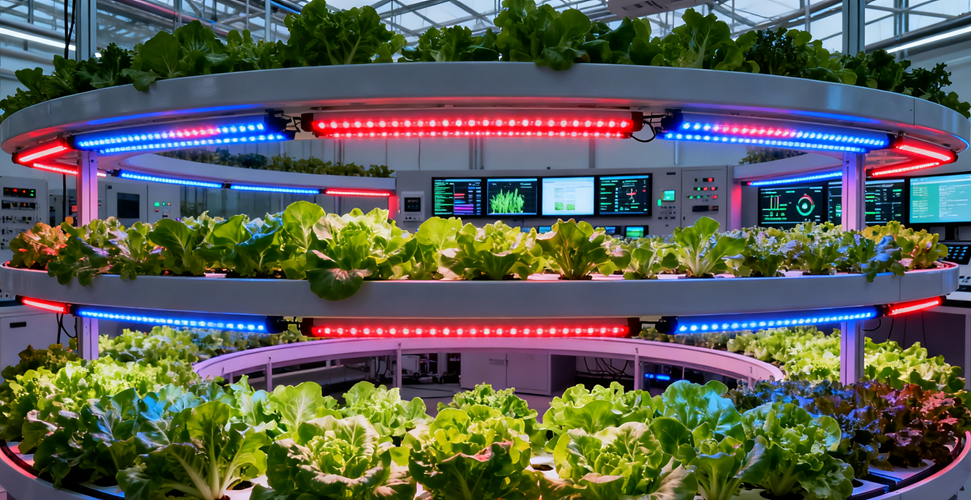
LED lighting enables precision growth in vertical farms, adjusting to each crop’s needs.
Intelligent Spectrum Control: Speaking the Language of Plants
Every plant species absorbs light differently. Blue light encourages leafy growth, while red light promotes flowering and fruiting. Green light helps penetrate deeper into the canopy, and far-red light triggers stretching and blooming responses. Smart agricultural LED systems use multi-channel tunable chips to replicate and optimize these natural effects.
How Intelligent Spectrum Control Works
Advanced sensors monitor environmental parameters such as temperature, humidity, CO₂ concentration, and light intensity. AI algorithms then adjust the LED spectrum in real time, ensuring that each growth phase — from seedling to harvest — receives the ideal wavelength combination.
For example:
- Seedling phase: Higher blue ratio to promote compact and strong roots.
- Vegetative phase: Balanced blue and red for dense foliage.
- Flowering phase: Enhanced red and far-red for fruit and bloom development.
These dynamic lighting programs can increase yields by up to 30%, reduce energy use by 40%, and ensure consistent quality across every growth cycle.
Data-Driven Farming: The Role of AI and IoT
The fusion of LED lighting with artificial intelligence (AI) and the Internet of Things (IoT) is what makes this generation of agricultural lighting truly “smart.”
In a connected farm, LEDs communicate with a network of sensors that collect continuous data on soil moisture, pH, ambient light, and plant health. AI platforms analyze this data and send commands to adjust light levels, nutrient delivery, and irrigation schedules.
Example: In an indoor strawberry farm, AI detects lower chlorophyll activity through spectral imaging and automatically increases red light intensity to boost photosynthesis efficiency.
Smart control dashboards allow farmers to:
- Visualize plant growth data in real time.
- Adjust light settings remotely via mobile or desktop apps.
- Integrate lighting control with HVAC, irrigation, and nutrient systems.
This synergy turns farming into a precision-controlled ecosystem, increasing yield while conserving resources.
A smart greenhouse system integrates LED lighting, irrigation, and environmental data analytics.
Case Studies: Global Adoption of Smart LED Agriculture
🌱 The Netherlands: Smart Horticulture Leadership
Dutch growers have long led the world in greenhouse innovation. In 2025, companies in the Netherlands are deploying AI-powered LED systems that monitor individual crop trays and fine-tune lighting recipes based on growth analytics. The result: 40% higher tomato yields with 25% less energy consumption.
🌾 United States: Vertical Farming in Urban Centers
In Chicago and New York, vertical farms use COB and CCT tunable LED strips to grow herbs and leafy greens year-round. By adjusting spectrum and intensity through data dashboards, farms achieve consistent quality and drastically reduce water use — up to 90% less than traditional agriculture.
🍓 Japan: Automation Meets LED Precision
Japan’s controlled environment agriculture (CEA) industry integrates robotics with intelligent lighting. Automated systems adjust LED wavelengths based on AI analysis of growth cameras. Factories like Spread Co.’s vertical lettuce farm now produce over 30,000 heads per day with minimal human intervention.
Sustainability and the Environmental Payoff
Sustainability is at the core of the LED revolution in agriculture. LEDs consume up to 70% less electricity than HPS lamps and emit significantly less heat, reducing cooling costs and extending the lifespan of fixtures.
In addition, smart LED systems can synchronize with renewable energy sources such as solar or microgrids, enabling off-grid or low-carbon operations — especially important for developing countries.
Environmental benefits include:
- Lower carbon footprint per kilogram of produce.
- Reduced food miles via localized production.
- Minimal pesticide and water use due to controlled environments.
LED-powered smart greenhouses combine solar panels and data analytics for sustainable farming.
Challenges Ahead
Despite remarkable progress, smart agricultural lighting faces challenges:
- High initial investment: Smart systems cost more upfront than conventional lighting.
- Complex integration: Requires reliable connectivity and advanced software infrastructure.
- Skill gap: Farmers need training to interpret and act on data insights.
However, as costs fall and knowledge spreads, the return on investment (ROI) is improving rapidly. Payback periods have shortened from 5–7 years to as little as 2–3 years in modern farms.
The Future Outlook: Intelligent Light, Intelligent Growth
The future of agriculture is intelligent, connected, and illuminated by LEDs. As smart lighting merges with AI-driven crop analytics, robotics, and renewable energy, we are entering an era of fully autonomous farming ecosystems.
In the next few years, we can expect:
- Self-learning lighting systems that evolve based on crop genetics and performance data.
- Integration with blockchain for transparent farm-to-table traceability.
- Global adoption of smart LED farming in both large-scale and local micro-farms.
Lighting is no longer just a passive factor in plant growth — it’s a strategic tool for managing the future of food security.
Conclusion: Growing Smarter, Greener, and Brighter
LEDs have transformed agriculture from a labor-intensive practice into a data-driven science of growth. By combining tunable light spectrums, AI automation, and sustainable design, smart agricultural lighting represents one of the most impactful technological shifts of our time.
In a world facing population growth, climate change, and resource scarcity, smart LED systems offer a solution that is efficient, scalable, and sustainable. They are helping us feed the planet — one photon at a time.
As a bespoke lighting solution provider, Yiholight specializes in high-quality LED strips and neon flex. Our products are engineered for durability, brightness, and ease of installation—trusted by B2B customers across the globe.
Contact us today to explore the best LED lighting for your business!
© [Yiholight] and [www.yiholight.com]. Unauthorized use or duplication of this material is strictly prohibited without express written permission from the site’s author or owner. Excerpts and links may be used, provided full, clear credit is given to [Yiholight] and [www.yiholight.com], with appropriate, specific direction to the original content.